
Running an MSME involves much more than delivering a good product or service. Having access to the right financing at the right time can help a business manage cash flow, invest in new equipment, expand operations, maintain inventory, and take advantage of new growth opportunities. This makes choosing the right MSME Funding Options in India an important part of long-term financial planning.
At Ram & Ram Associates LLP, we understand that every business has different financial requirements. Instead of recommending the same funding approach to every client, we first look at the business model, financial position, funding requirement, and future objectives. This helps us assess suitable financing structures and guide businesses in preparing for discussions with lenders, investors, or other funding institutions.
MSMEs may require finance for several purposes, including working capital, machinery and equipment, technology upgrades, business expansion, inventory, infrastructure, or new projects. The most suitable financing option depends on factors such as the purpose of the funds, cash-flow position, repayment capacity, existing liabilities, business performance, credit profile, and the contribution the promoters can make.
The objective should not simply be to raise more money, but to choose a financing structure that supports business growth without creating unnecessary financial pressure.
The key is not simply to ask, “How much funding can my business get?”
The better question is:
“What type and amount of capital does my business actually need, and what financing structure can it responsibly support?”
Disclaimer: This article is for general educational and informational purposes only. Government schemes, eligibility criteria, lending policies, interest rates, documentation requirements and financing terms can change. Funding approval is determined by the relevant lender, institution, investor or authority. Businesses should obtain professional advice based on their specific circumstances.
MSME Funding Options in India: Understanding the Right Financing Route
The MSME Funding Options in India available to a business can broadly be divided into traditional debt, government-supported financing, working-capital facilities, asset-backed funding, equity or investment capital, and alternative financing.
The right choice depends on what the money is being used for.
For example:
- Inventory purchase may require working-capital finance.
- Machinery acquisition may require equipment or term financing.
- Expansion may require a combination of debt and promoter contribution.
- A technology startup may require equity or alternative investment.
- Short-term receivables pressure may require invoice-based financing.
- A new project may require structured project finance.
This is why MSME funding should be treated as a financial strategy rather than simply a loan application.
MSME Funding Consultants in Hyderabad: Why Professional Guidance Matters
Businesses looking for MSME funding consultants in Hyderabad often begin by comparing banks and loan products. That is understandable, but it may not be enough.
Before approaching a lender, a business should understand:
- How much funding is actually required?
- What is the purpose of the funding?
- How much can the promoter contribute?
- What existing debt does the business have?
- What monthly repayment can the business comfortably handle?
- What collateral may be available?
- What does the projected cash flow look like?
- Are the financial statements properly prepared?
- Is the business eligible for any applicable government-backed financing support?
MSME funding consultants can help businesses organise these questions before approaching potential funding providers.
The goal should be to improve the quality of the funding proposal rather than make unrealistic promises about approval.
MSME Loan Consultants in Hyderabad: Preparing Before Applying
MSME loan consultants in Hyderabad can assist businesses in evaluating their borrowing requirements and preparing financially for the loan process.
A common mistake is deciding the loan amount first and working backward to justify it.
A better approach is:
Business requirement → Project/working-capital requirement → Funding gap → Repayment capacity → Suitable financing structure
For example, if a company needs ₹3 crore for machinery, it should not automatically apply for ₹5 crore simply because the higher amount is available.
The business should establish:
- Machinery cost
- Installation expenses
- Taxes and related costs
- Expected production capacity
- Revenue impact
- Working-capital requirement
- Expected cash flow
- Existing debt obligations
That creates a more defensible financing requirement.
MSME Finance Consultants in Hyderabad: Looking Beyond the Loan Amount
MSME finance consultants in Hyderabad can help management evaluate the broader financial consequences of borrowing.
A loan affects:
- Cash flow
- Interest expense
- Balance sheet
- Debt obligations
- Working capital
- Profitability
- Financial risk
A business that can technically qualify for a loan may not necessarily be in a position to comfortably service it.
This distinction matters.
Eligibility is not the same as affordability.
Business Funding Consultants in Hyderabad: Choosing the Appropriate Structure
Business funding consultants in Hyderabad can help businesses examine different sources of capital rather than treating bank loans as the only answer.
Depending on the circumstances, a business may consider:
- Term loans
- Working-capital facilities
- Equipment finance
- Invoice financing
- Trade finance
- Business lines of credit
- Government-supported schemes
- Equity investment
- Strategic investors
- Alternative financing
- Promoter contribution
The appropriate structure depends on the nature and stage of the business.
MSME Funding Services in Telangana
Businesses seeking MSME funding services in Telangana may have different financial requirements depending on their industry and growth stage.
A manufacturing MSME may require substantial capital for machinery.
A trading business may need working capital to purchase inventory.
A service business may require funds to hire employees or build technology.
A growing enterprise may require expansion capital.
Therefore, MSME financing should be linked to the business model and cash-flow cycle.
MSME Funding Consultants in Andhra Pradesh
Businesses looking for MSME funding consultants in Andhra Pradesh should similarly assess the purpose of funding before selecting a financing option.
For businesses operating in sectors such as manufacturing, trading, agriculture-related activities, services, logistics, technology and other industries, the funding requirement can vary significantly.
Professional financial analysis can help identify whether the business needs:
- Short-term working capital
- Long-term capital
- Asset financing
- Project funding
- Expansion funding
- Structured finance
- Alternative financing
Business Finance Consultants in Hyderabad
Business finance consultants in Hyderabad can help business owners look at financing from a broader perspective.
Instead of asking only:
“Which lender offers the lowest rate?”
management should also ask:
“Which financing structure best matches our business cash flows?”
For instance, a short-term borrowing facility may not be appropriate for a long-term asset that will generate returns over several years.
Similarly, using long-term debt for a temporary working-capital requirement may increase unnecessary financing costs.
MSME Loan Advisory Services in Hyderabad
MSME loan advisory services in Hyderabad can help businesses prepare for financing discussions by reviewing financial information, funding requirements, projections and repayment capacity.
A well-prepared financing proposal should generally communicate:
- Business background
- Promoter experience
- Product or service
- Market opportunity
- Existing financial position
- Funding requirement
- Purpose of funds
- Projected revenue
- Projected cash flow
- Repayment capability
- Security or collateral, where applicable
- Key business risks
A lender needs enough information to understand how the proposed financing fits into the business.
MSME Funding Advisory Services
MSME funding advisory services can help businesses compare financing alternatives before committing to a particular structure.
For example, consider an MSME requiring ₹2 crore for expansion.
Potential options could include:
- Term debt
- Promoter contribution
- Equipment financing
- Working-capital finance
- Equity investment
- A combination of these
The best option depends on the company’s financial position and the purpose of the funds.
A blended structure may sometimes be more appropriate than relying entirely on one source.
Business Finance Advisory for MSMEs
Business finance advisory should not stop once the loan is approved.
Businesses also need to monitor:
- Debt utilisation
- Interest obligations
- Cash flow
- Working capital
- Budget variance
- Profitability
- Repayment schedules
This is particularly important when funding is used for expansion.
More funding can create more growth – but it can also create more financial obligations.
Financial Advisory for MSMEs
Financial advisory for MSMEs can help owners make decisions based on numbers rather than assumptions.
For example, an owner may believe:
“If I double production, profits will double.”
A financial analysis may reveal that doubling production also requires:
- More inventory
- More staff
- More receivables
- More machinery
- More working capital
- Higher logistics expenses
Revenue growth does not automatically translate into cash-flow growth.
Best MSME Funding Options in India
When businesses search for the Best MSME funding options in India, there is no single answer that applies to every MSME.
The best option depends on the purpose of funding.
1. Term Loans
Term loans are commonly used for longer-term requirements such as:
- Machinery
- Infrastructure
- Expansion
- Business assets
- New facilities
The repayment period should ideally align with the useful economic life and cash-generating capacity of the asset or project.
2. Working-Capital Finance
Working-capital finance can help businesses manage the gap between paying suppliers and collecting customer payments.
It can be relevant for businesses with:
- High inventory requirements
- Longer customer credit periods
- Seasonal demand
- Rapid sales growth
3. Equipment Financing
Businesses purchasing machinery or equipment may consider financing specifically linked to the asset.
This can help preserve working capital for day-to-day operations.
4. Invoice-Based Financing
Businesses with strong receivables but delayed customer payments may explore invoice-based financing, subject to eligibility and applicable terms.
This can potentially convert eligible receivables into earlier cash flow.
5. Trade Finance
Businesses involved in domestic or international trade may require financing for purchases, inventory or receivables.
6. Equity Investment
Businesses with high-growth potential may consider equity capital instead of relying entirely on debt.
Equity does not create the same repayment obligation as a conventional loan, but it can involve ownership dilution and investor expectations.
7. Alternative Financing
Alternative financing can provide additional options for businesses that do not fit traditional lending structures or require a different financing model.
How to Get MSME Funding in India
Businesses asking How to get MSME funding in India should start with financial preparation rather than immediately submitting multiple loan applications.
A practical process is:
Step 1: Define the requirement
Identify exactly why the money is required.
Step 2: Calculate the funding gap
Determine how much can be funded internally and how much external capital is required.
Step 3: Review financial records
Check financial statements, tax records, bank statements, debt obligations and receivables.
Step 4: Assess repayment capacity
Prepare realistic cash-flow projections.
Step 5: Compare financing options
Review debt, equity and alternative financing.
Step 6: Prepare documentation
Ensure the business proposal and financial information are organised.
Step 7: Approach suitable funding providers
The funding provider should match the nature and size of the requirement.
Step 8: Review the financing terms
Do not evaluate financing only on the interest rate. Consider fees, tenure, repayment structure, collateral, covenants and other applicable terms.
How to Finance an MSME Business
The question How to finance an MSME business depends largely on the business’s stage and purpose.
A new business may require startup capital.
An established business may require working capital.
A growing company may need expansion finance.
A manufacturing company may need asset financing.
A project-oriented business may need project funding.
Therefore, financing should be matched with the economic purpose of the capital.
Government Funding Options for MSMEs
Businesses exploring Government funding options for MSMEs should investigate applicable government schemes and institutional programmes based on their eligibility.
Such programmes may provide various forms of support, including credit facilitation, guarantees, subsidies or other assistance depending on the specific scheme.
However, businesses should not assume that government support automatically means free money or guaranteed funding.
Eligibility, documentation, sector requirements, business classification, lender participation and other conditions may apply.
Government schemes can also change over time.
Therefore, businesses should verify the current scheme conditions through the relevant official authorities or participating institutions before making decisions.
Business Loan Options for MSMEs
Business loan options for MSMEs can include several forms of financing.
Some common categories include:
- Term loans
- Working-capital loans
- Equipment finance
- Cash-credit facilities
- Overdraft facilities
- Invoice financing
- Trade finance
- Business lines of credit
- Secured loans
- Certain unsecured business financing products
The appropriate option depends on business requirements and eligibility.
How to Get a Business Loan for an MSME
For businesses asking How to get a business loan for an MSME, preparation is critical.
Lenders may examine factors such as:
- Business vintage
- Revenue
- Profitability
- Credit history
- Existing obligations
- Bank transactions
- Tax compliance
- Financial statements
- Promoter profile
- Collateral, where applicable
- Repayment capacity
A business should therefore avoid applying blindly to multiple lenders.
Multiple applications without a clear strategy can complicate the financing process and may not address the underlying reason for rejection if the financial proposal itself is weak.
Alternative Financing Options for MSMEs
Alternative financing options for MSMEs can be considered when traditional borrowing is not the only appropriate route.
Potential alternatives may include:
- Equity capital
- Strategic investment
- Invoice financing
- Supply-chain finance
- Asset-backed financing
- Revenue-linked arrangements, where applicable
- Peer or marketplace-based financing models, subject to applicable regulations
- Promoter funding
- Private investment
Each option has different costs, risks and implications.
Businesses should understand the commercial terms before accepting alternative capital.
Best Financing Options for Small Businesses in India
The Best financing options for small businesses in India depend on what the money is intended to achieve.
For example:
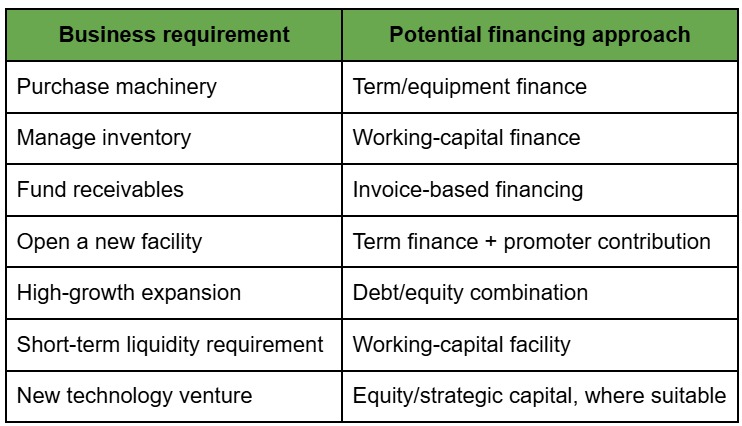
This is only a general framework. Actual suitability depends on business-specific circumstances.
How MSMEs Can Raise Capital
How MSMEs can raise capital is not limited to taking a bank loan.
An MSME can potentially raise capital through:
- Promoter contribution
- Debt
- Equity
- Strategic investors
- Asset financing
- Receivables financing
- Working-capital facilities
- Government-supported financing programmes
- Alternative financing
The key consideration is the cost, risk and suitability of each source.
MSME Funding Options for Business Expansion
MSME funding options for business expansion should be evaluated against the expected financial return from expansion.
Before borrowing for expansion, management should estimate:
- Additional revenue
- Additional gross margin
- Additional operating expenses
- Additional working capital
- Capital expenditure
- Debt servicing
- Expected break-even period
- Downside scenario
Expansion should create enough economic value to justify the capital invested.
Working Capital Funding for MSMEs
Working capital funding for MSMEs is particularly important for businesses where cash gets tied up in inventory or receivables.
Consider a company that sells products worth ₹1 crore every month but provides customers 60 days of credit.
The company may need substantial working capital even if its sales are strong.
Similarly, seasonal businesses may require additional working capital during peak inventory periods.
Working capital should therefore be calculated based on the business cycle rather than simply using a standard percentage of revenue.
Funding Options for New MSME Businesses
Funding options for new MSME businesses can be more challenging because new businesses often lack a long operating history.
Potential funding sources may include:
- Promoter contribution
- Family or private investment
- Eligible government-supported programmes
- Business loans where eligibility permits
- Equipment financing
- Equity investment
- Strategic investors
A new business should focus heavily on:
- Business plan
- Promoter credibility
- Market opportunity
- Financial projections
- Funding requirement
- Unit economics
- Cash-flow planning
MSME Loans: What Businesses Should Consider
MSME loans can be useful tools when borrowing is appropriately structured.
However, businesses should consider more than the headline interest rate.
Review:
- Interest rate
- Processing fees
- Tenure
- Repayment schedule
- Prepayment conditions
- Security requirements
- Guarantees
- Other charges
- Financial covenants, where applicable
The lowest advertised rate is not automatically the lowest-cost financing option.
MSME Financing and Cash Flow
MSME financing should be evaluated against actual business cash flow.
A business may have healthy annual profits but experience monthly cash shortages.
This is why financing decisions should consider:
Profitability + Liquidity + Repayment Capacity + Business Growth
A loan that looks affordable on paper may become difficult if customer payments are delayed or project implementation takes longer than expected.
MSME Business Loans for Growth
MSME business loans can support growth when the borrowed capital is invested productively.
Examples include:
- New machinery
- Additional production capacity
- Technology
- Distribution expansion
- Inventory
- New locations
- Business infrastructure
However, borrowing for expansion without analysing expected returns can increase financial pressure.
MSME Finance Options and Capital Structure
MSME finance options should be assessed alongside the company’s overall capital structure.
A business with significant existing debt may need to reconsider additional borrowing.
A business with strong cash flows but insufficient growth capital may be better positioned for structured debt.
A high-growth startup may require equity rather than traditional debt.
This is why capital structure should be considered before financing is finalised.
Project Funding Consultants for MSMEs
Some MSMEs require funding for large expansion projects rather than ordinary working capital.
In such cases, Project funding consultants may assist with project-level financial preparation.
A project funding assessment can include:
- Project cost
- Promoter contribution
- Debt requirement
- Working capital
- Projected revenue
- Operating expenses
- Cash flows
- Repayment capacity
- Project risks
The project should be financially viable before funding is pursued.
Capital Structuring Consultants for Growing MSMEs
Capital structuring consultants can help businesses evaluate the appropriate mix of:
- Equity
- Debt
- Promoter contribution
- Working capital
- Other financing
The goal should be to create a structure that supports growth while keeping financial risk within manageable limits.
Business Loan Consulting Services
Business loan consulting services can help management understand the financial requirements and prepare for lender discussions.
This may include:
- Funding requirement assessment
- Financial analysis
- Documentation review
- Projection preparation
- Repayment analysis
- Financing comparison
However, businesses should remain responsible for reviewing and accepting the final financing terms.
Financial Advisory for MSMEs: Making Better Funding Decisions
Financial advisory for MSMEs is not simply about helping businesses obtain more money.
It is about helping businesses make better decisions about money.
The right funding should:
- Serve a clear business purpose.
- Match the business’s cash-flow cycle.
- Be affordable.
- Have an appropriate repayment structure.
- Support productive investment.
- Avoid unnecessary financial risk.
That is the foundation of responsible MSME funding.
How Ram & Ram Associates LLP Supports MSMEs
At Ram & Ram Associates LLP, we understand that MSME owners are often managing sales, employees, operations, customers, compliance and finance simultaneously.
Our role is to help bring financial clarity into important funding decisions.
Our MSME funding services in Telangana, MSME funding consultants in Hyderabad, MSME loan consultants in Hyderabad, MSME finance consultants in Hyderabad, Business funding consultants in Hyderabad, MSME funding consultants in Andhra Pradesh, and Business finance consultants in Hyderabad can support businesses in areas such as:
- Funding requirement assessment
- Financial planning
- Cash-flow analysis
- Business finance advisory
- Funding strategy
- Capital structuring
- Financial projections
- Project funding preparation
- Business loan advisory
- Management financial reporting
Our objective is not to push a particular funding product.
It is to understand the business first and then evaluate the financing requirement.
>>>Also Read: Strategic Project Funding: How Businesses Can Raise Capital
Frequently Asked Questions
1. What are the main MSME Funding Options in India?
The major MSME Funding Options in India can include term loans, working-capital facilities, equipment finance, invoice financing, trade finance, government-supported programmes, equity investment, strategic investment and other alternative financing structures.
2. How to get MSME funding in India?
To understand How to get MSME funding in India, begin by identifying the exact purpose and amount required. Then assess financial statements, cash flow, repayment capacity, promoter contribution and suitable financing options before approaching relevant lenders or funding providers.
3. What are the best MSME funding options for business expansion?
MSME funding options for business expansion may include term finance, equipment financing, working-capital facilities, promoter contribution, equity investment or a combination of financing sources. The appropriate option depends on the expansion plan and financial position.
4. What are the best financing options for small businesses in India?
The Best financing options for small businesses in India depend on the purpose of the funds. Working-capital facilities may suit inventory and receivables requirements, while term financing may be more appropriate for long-term assets or expansion.
5. How can MSMEs raise capital without relying only on bank loans?
How MSMEs can raise capital can involve promoter contribution, equity investors, strategic investors, invoice financing, asset-backed financing, government-supported programmes and other alternative financing options, depending on eligibility and commercial suitability.
6. What is the role of MSME funding consultants?
MSME funding consultants can help businesses analyse funding requirements, prepare financial information, evaluate financing alternatives and organise a funding proposal. They cannot guarantee that a lender or investor will approve financing.
7. Are government funding options available for MSMEs?
Yes, there are various Government funding options for MSMEs and government-supported credit or assistance programmes. However, eligibility, benefits and conditions vary by scheme and can change. Businesses should verify the current requirements with the relevant official authority or participating institution.
8. Should an MSME choose debt or equity?
There is no universal answer. Debt creates repayment obligations but generally does not dilute ownership. Equity does not have conventional loan repayment obligations but may involve ownership dilution and investor expectations. The decision should consider cash flow, growth potential, risk and the business’s capital structure.
Conclusion: The Right MSME Funding Is About More Than Getting a Loan
For an MSME, funding can be the difference between maintaining the status quo and taking the next step toward growth.
But obtaining capital should never become the only objective.
The more important objective is obtaining the right capital, in the right amount, for the right purpose, under terms the business can realistically support.
At Ram & Ram Associates LLP, we believe that effective financial planning starts by understanding the business before discussing financing.
Our approach is focused on helping businesses evaluate their financial position and make informed funding decisions.
Whether your requirement involves working capital, machinery, expansion, a new business project, technology investment or another growth initiative, the financing structure should fit the economics of the business.
At Ram & Ram Associates LLP, we help business owners evaluate their funding requirements, understand available financing options, and make informed decisions based on their financial position and growth plans. Our approach is focused on providing practical financial guidance and helping businesses choose funding solutions that align with their objectives and repayment capacity.
Funding should solve a business problem – not create a bigger financial problem later.
Before accepting any loan or investment, understand the total cost of capital, repayment obligations, risks, cash-flow implications and long-term effect on your business.
Because sustainable growth is not simply about raising more capital.
It is about deploying capital intelligently and building a business capable of generating value from it.
Ram & Ram Associates LLP
Business Finance Advisory | MSME Funding | Capital Structuring | Financial Advisory | Business Funding Solutions
Visit Ram & Ram Associates LLP
Financial Disclaimer: This content is for general informational purposes and should not be considered financial, investment, tax, legal, lending or professional advice. Financing availability, eligibility, interest rates, government schemes and lender requirements may change. Businesses should independently verify applicable terms and obtain professional advice before making funding decisions.
Follow Us on Social Media! Stay Connected & Stay Ahead! 🤓