

Choosing the right financial leadership can make a significant difference to how a business manages cash, controls costs, evaluates investments, plans growth, and responds to financial risks. For many businesses, the question is no longer simply whether they need a Chief Financial Officer, but which model of CFO support makes the most sense for their current stage and objectives.
The comparison between a Virtual CFO vs Full-Time CFO is particularly relevant for startups, MSMEs, growing companies, and businesses entering a new phase of expansion. A full-time CFO becomes part of the organisation and typically works exclusively for the business, while a Virtual CFO provides senior-level financial expertise on a flexible or part-time basis.
At Ram & Ram Associates LLP, we recognise that every business has different financial needs and operational priorities. While larger organisations may benefit from having a dedicated finance executive overseeing their financial function, growing businesses may prefer access to experienced financial leadership without the cost of maintaining a full-time senior executive position.
A flexible CFO arrangement can provide businesses with support in areas such as financial planning, cash-flow management, budgeting, forecasting, reporting, risk management, funding preparation, and strategic decision-making. The right approach ultimately depends on the size, complexity, growth stage, and financial requirements of the business.
This guide explains the Difference between Virtual CFO and Full-Time CFO, compares their roles and responsibilities, examines the Benefits of hiring a Virtual CFO and Benefits of hiring a full-time CFO, and outlines the key factors businesses should consider before choosing either model. The objective is to help business owners make a practical decision based on their actual financial needs rather than simply choosing the more expensive or more convenient option.
Disclaimer: This article is intended for general business and financial information. Every organisation has different requirements, financial structures, risks, and regulatory obligations. Professional advice should be obtained based on the specific circumstances of your business.
Virtual CFO vs Full-Time CFO: Understanding the Right Choice for Your Business
The decision between a Virtual CFO vs Full-Time CFO should begin with one question: What does your business actually need from its financial leadership?
A CFO is not simply a senior accountant. While accounting focuses heavily on recording and reporting financial transactions, CFO-level responsibilities can include financial strategy, forecasting, cash-flow planning, capital allocation, risk management, management reporting, fundraising, business performance analysis, and strategic decision-making.
A Full-time CFO generally works exclusively for one organisation and is deeply involved in its financial operations and strategic planning. A Virtual CFO, meanwhile, provides many senior-level CFO capabilities on an outsourced, fractional, or flexible basis.
Neither approach is automatically superior.
For a large organisation with complex financial operations, multiple business units, significant regulatory requirements, investors, and a large finance team, a full-time CFO may be appropriate.
For a startup or growing MSME that needs senior financial expertise but cannot justify the cost of a full-time executive, Virtual CFO services for businesses may provide a more practical solution.
The key is matching the CFO model to the organisation’s size, complexity, growth stage, financial requirements, and strategic objectives.
Difference between Virtual CFO and Full-Time CFO
The Difference between Virtual CFO and Full-Time CFO is primarily related to the structure and depth of engagement.
A Full-Time CFO is an internal executive. They generally work exclusively for one company, participate in management meetings, oversee the finance function, and may directly manage finance employees.
A Virtual CFO operates as an external strategic finance partner. Depending on the engagement, they may work with the management team weekly, monthly, or according to specific financial requirements.
Both can potentially provide:
- Financial planning and analysis
- Cash-flow management
- Budgeting and forecasting
- Financial performance analysis
- Management reporting
- Risk assessment
- Financial controls
- Business strategy support
- Funding preparation
- Capital planning
The difference is largely how those capabilities are delivered and how deeply the CFO is embedded in the organisation.
Virtual CFO vs In-House CFO: How Are They Different?
The Virtual CFO vs in-house CFO comparison is another way of looking at the same decision.
An in-house CFO is physically and organisationally embedded within the business. This can be useful where constant financial involvement is required.
A Virtual CFO may not be present in the office every day, but can still participate in management meetings, review financial reports, analyse business performance, prepare forecasts, advise on cash flow, and support major financial decisions.
Technology has made remote financial collaboration significantly easier. Accounting systems, dashboards, cloud-based documents, video meetings, financial reporting platforms, and digital communication tools allow senior financial professionals to work closely with management without being physically present every day.
However, businesses should not assume that technology alone makes every Virtual CFO arrangement effective. The quality of reporting, access to accurate data, communication processes, defined responsibilities, and regular management reviews are equally important.
Virtual CFO vs Full-Time CFO: Which Is Better for a Growing Business?
When businesses ask Virtual CFO vs full-time CFO which is better, there is no universal answer.
A growing company may need CFO-level thinking long before it needs a full-time CFO.
For example, imagine a company with annual revenue growing rapidly but with unpredictable cash flow. The management team may need help with:
- Monthly cash-flow forecasts
- Working-capital planning
- Budget controls
- Profitability analysis
- Financial dashboards
- Funding preparation
- Business expansion decisions
Hiring a full-time CFO may be difficult to justify at that stage.
A Virtual CFO could provide the required expertise while allowing the company to allocate resources toward sales, operations, technology, employees, or expansion.
On the other hand, if the company has a large finance department, multiple subsidiaries, complex funding arrangements, investor reporting requirements, and daily strategic financial demands, a full-time CFO may be the more appropriate structure.
When Does a Business Need a Virtual CFO?
The question When does a business need a Virtual CFO usually arises when financial decisions become too important to leave entirely to bookkeeping or routine accounting functions.
A business may consider Virtual CFO support when:
- Revenue is increasing rapidly.
- Cash flow is becoming difficult to predict.
- Management lacks reliable financial dashboards.
- Profitability differs significantly between products or services.
- The company is considering external funding.
- The business is expanding into new markets.
- Financial decisions are being made without sufficient data.
- Budgeting is inconsistent.
- Working capital is under pressure.
- The existing finance team needs senior-level guidance.
A Virtual CFO can bridge the gap between accounting information and strategic decision-making.
Virtual CFO Services: More Than Accounting
A common misconception is that Virtual CFO services are simply outsourced accounting.
They are not the same.
Accounting primarily records and reports financial transactions. CFO-level advisory goes further by helping management interpret financial information and use it for decision-making.
For example:
Accounting question:
“How much revenue did the company generate last month?”
CFO question:
“Why did revenue increase but operating cash decline, and what should management do about it?”
Similarly:
Accounting question:
“What are our current expenses?”
CFO question:
“Which expenses are generating value, which are unnecessary, and how will the cost structure affect profitability over the next 12 months?”
This distinction is fundamental when evaluating Virtual CFO services for businesses.
Financial Planning and Analysis Services
Strong financial management begins with understanding where the business currently stands and where it is going.
Financial planning and analysis services can help businesses examine:
- Revenue trends
- Gross margins
- Operating expenses
- EBITDA
- Cash flow
- Working capital
- Customer profitability
- Product profitability
- Budget variances
- Financial forecasts
The purpose is not simply to produce reports. The objective is to turn financial data into information management can use.
Cash Flow Management Services
Profit does not always mean cash.
A profitable business can still face financial pressure if customers pay late, inventory remains unsold, expenses increase rapidly, or working capital is poorly managed.
Cash flow management services can help businesses monitor:
- Receivables
- Payables
- Inventory
- Working capital
- Cash conversion cycles
- Upcoming financial commitments
- Funding requirements
A CFO can help management understand not only how much money the business has, but also when money is expected to enter and leave the business.
This is especially important for growing companies.
Business Budgeting and Forecasting Services
Businesses should not treat budgets as static documents prepared once a year.
Business budgeting and forecasting services can support ongoing financial planning by comparing actual performance against expected performance.
For example:
If the business expected ₹50 lakh in monthly revenue but generated ₹40 lakh, management should understand:
- What caused the shortfall?
- Was it temporary or structural?
- Which products or services underperformed?
- What happened to margins?
- Should expenses be adjusted?
- Does the cash-flow forecast need revision?
This is where CFO-level analysis becomes valuable.
Financial Risk Management Services
Every business faces financial risks.
These can include:
- Cash-flow risk
- Customer concentration risk
- Credit risk
- Interest-rate exposure
- Foreign exchange exposure
- Operational cost risk
- Funding risk
- Compliance-related financial risk
Financial risk management services help management identify and monitor these risks before they become serious financial problems.
The exact approach depends on the industry and financial structure of the business.
Management Reporting Services
Management cannot make good financial decisions without timely and understandable information.
Management reporting services can provide structured reports covering areas such as:
- Revenue
- Profitability
- Cash flow
- Receivables
- Payables
- Budget variance
- Business-unit performance
- Key financial indicators
A good management report should answer business questions rather than simply contain numbers.
For example, instead of presenting only revenue figures, a CFO may help management understand which revenue streams are profitable, sustainable, and strategically important.
Benefits of Hiring a Virtual CFO
There are several potential Benefits of hiring a Virtual CFO, particularly for businesses that need senior financial expertise without a full-time executive structure.
Access to Senior Financial Expertise
A business can obtain CFO-level strategic guidance without necessarily creating a full-time CFO position.
Flexible Engagement
The scope can often be structured around the organisation’s requirements.
Support During Growth
A Virtual CFO can help management navigate expansion, new investments, funding requirements, and changes in working capital.
Better Financial Visibility
Regular reporting, forecasting, and analysis can provide management with a clearer understanding of business performance.
Strategic Decision Support
A Virtual CFO can contribute financial analysis to decisions involving expansion, pricing, investments, cost control, and funding.
Funding Preparation
Businesses seeking loans, investors, or project funding may benefit from stronger financial projections, reporting, and documentation.
These are some of the reasons businesses consider Professional Virtual CFO services.
Benefits of Hiring a Full-Time CFO
The Benefits of hiring a full-time CFO are particularly relevant for businesses where financial leadership needs to be deeply embedded into daily operations.
A Full-Time CFO can provide:
- Continuous involvement in management decisions
- Direct leadership of the finance department
- Immediate access to financial information
- Strong internal coordination
- Close oversight of controls
- Investor and board-level engagement
- Direct supervision of finance personnel
- Long-term organisational knowledge
For companies with substantial financial complexity, these advantages can be significant.
A full-time CFO can become deeply familiar with the company’s operations, people, customers, contracts, risks, and strategic priorities.
Virtual CFO Consulting Services for Startups
Startups often operate with limited resources while facing major financial decisions.
Virtual CFO consulting services can help founders understand:
- Burn rate
- Runway
- Unit economics
- Pricing
- Cash requirements
- Funding requirements
- Financial projections
- Investor expectations
- Budget allocation
For a startup, hiring a senior financial executive too early can put unnecessary pressure on the cost structure.
This is why Virtual CFO for startups can be a practical model during early and growth stages.
The exact timing depends on the startup’s complexity, funding stage, revenue, financial operations, and growth plans.
Virtual CFO for MSMEs
MSMEs often have strong operational expertise but may not have a senior finance executive internally.
A Virtual CFO for MSMEs can help bridge that gap.
Common areas of support include:
- Cash-flow planning
- Working-capital management
- Budgeting
- Financial reporting
- Cost analysis
- Business forecasting
- Funding preparation
- Financial controls
- Management decision support
For a growing MSME, these functions can become increasingly important as the business moves from informal decision-making to structured financial management.
Outsourced CFO Services vs Full-Time CFO
Outsourced CFO services can be useful where the company requires experienced financial leadership but does not require a CFO working exclusively inside the organisation every day.
This model may be particularly relevant for:
- Startups
- MSMEs
- Family-owned businesses
- Growing companies
- Professional service firms
- Businesses preparing for funding
- Companies undergoing restructuring
A full-time CFO may be more appropriate when the organisation has sufficient scale and complexity to justify a dedicated executive.
The decision should therefore be based on business requirements rather than simply comparing job titles.
Fractional CFO Services: A Flexible Middle Ground
Fractional CFO services sit between basic accounting support and a traditional full-time CFO role.
A fractional CFO may work with a company for a defined number of hours or days each month, depending on requirements.
This can give management access to senior-level financial expertise while maintaining flexibility.
For example, a growing company may initially require strategic CFO involvement a few days per month. As the company expands, the engagement can potentially increase.
This makes the model adaptable to changing business requirements.
CFO Advisory Services for Strategic Decision-Making
CFO advisory services should not be limited to historical reporting.
A strategic CFO can support management with forward-looking questions such as:
- Should we expand?
- Can we afford this investment?
- Which product line should receive more capital?
- How much working capital will growth require?
- Should we raise debt or equity?
- What is our expected cash position six months from now?
- Which expenses should be controlled?
- Are our margins sustainable?
This is where Strategic CFO services become particularly valuable.
Strategic CFO Services for Business Growth
Strategic CFO services focus on connecting financial management with broader business objectives.
A CFO may help management develop:
- Financial strategies
- Growth plans
- Capital allocation strategies
- Funding plans
- Profitability improvement strategies
- Risk-management frameworks
- Financial KPIs
- Long-term forecasts
The CFO’s role is therefore not simply to explain what happened last month, but to help management prepare for what happens next.
Business Financial Advisory Services
Business financial advisory services can provide management with an independent financial perspective.
This can be especially valuable when business owners are heavily involved in daily operations and do not have enough time to analyse financial information objectively.
Financial advisory can support decisions involving:
- Expansion
- Cost restructuring
- Funding
- Investment
- Working capital
- Profitability
- Business valuation
- Financial controls
The precise scope should be defined according to the organisation’s needs.
Strategic Financial Advisory Services
Strategic financial advisory services take financial analysis into broader business strategy.
For example, suppose a company is considering opening three new branches.
A purely operational approach might ask:
“Can we open the branches?”
A strategic financial approach would examine:
- Initial investment
- Expected revenue
- Operating costs
- Break-even period
- Cash-flow requirements
- Funding requirements
- Expected return
- Downside risk
- Impact on existing operations
This is the difference between simply having financial data and using that data strategically.
CFO Services in India: What Should Businesses Expect?
Businesses searching for CFO services in India should clearly define what they expect from the engagement.
A CFO service may include some combination of:
- Financial planning
- Cash-flow management
- Budgeting
- Forecasting
- MIS reporting
- Financial analysis
- Risk management
- Funding support
- Capital planning
- Strategic advisory
Not every business needs every service.
The engagement should be designed around the company’s actual financial challenges and objectives.
Virtual CFO Services for Businesses: Who Should Consider Them?
Virtual CFO services for businesses may be particularly useful for organisations that:
- Have an established accounting function but lack strategic financial leadership.
- Are experiencing rapid growth.
- Need stronger financial controls.
- Want regular management reporting.
- Are preparing for fundraising.
- Need cash-flow visibility.
- Are evaluating expansion.
- Want professional financial forecasting.
- Need help with financial decision-making.
The service is not necessarily restricted to small companies. Even larger businesses may use external CFO expertise for specific projects or periods of transition.
Is a Virtual CFO Better Than a Full-Time CFO?
So, Is a Virtual CFO better than a full-time CFO?
Not universally.
A Virtual CFO may be better suited to a company that needs senior financial expertise but does not require a CFO’s daily physical involvement.
A Full-Time CFO may be better suited to an organisation where finance is highly complex and requires continuous executive leadership.
Consider this simple comparison:
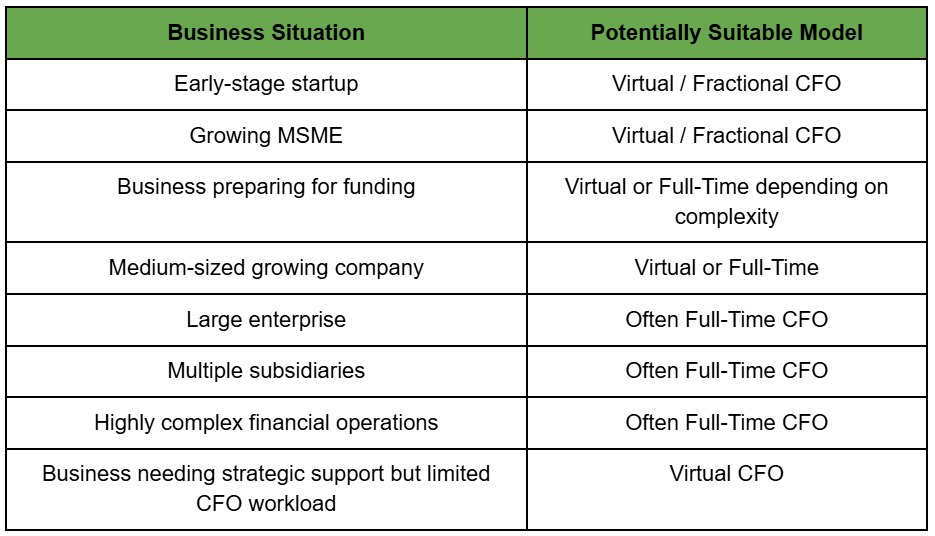
This is a general guide, not a universal rule.
Virtual CFO Consulting vs Full-Time CFO: Cost Considerations
Cost is naturally one of the biggest factors in the Virtual CFO consulting decision.
A Full-Time CFO typically represents a substantial employment commitment involving:
- Salary
- Benefits
- Bonuses
- Recruitment costs
- Executive infrastructure
- Professional development
- Other employment-related expenses
Virtual CFO arrangements may provide greater flexibility because the company pays for an agreed scope of professional services rather than maintaining a full-time executive position.
However, businesses should avoid choosing a CFO model based only on the lowest cost.
The more important question is:
What financial value can the CFO create or protect for the business?
Better cash-flow management, improved profitability, reduced financial risks, stronger funding preparation, and better capital allocation can have a much greater financial impact than the difference in professional fees.
How to Choose the Right CFO Model
Before deciding between a Virtual CFO and Full-Time CFO, management should assess:
1. Business Size
A larger organisation may require deeper internal financial leadership.
2. Financial Complexity
Multiple entities, investors, funding arrangements, international operations, or complex reporting can increase the need for dedicated CFO involvement.
3. Growth Stage
Fast-growing businesses may need CFO-level expertise before they are ready for a full-time executive.
4. Funding Requirements
Businesses preparing for loans, investors, or project funding may benefit from experienced financial guidance.
5. Existing Finance Team
If the business already has accountants and finance managers, a Virtual CFO can potentially sit above the existing structure and provide strategic direction.
6. Management Requirements
If the leadership team needs daily financial involvement, a full-time CFO may be more appropriate.
Virtual CFO vs Full-Time CFO: Two Practical Examples
Example 1: Growing MSME
An MSME has ₹20 crore in annual revenue and is expanding into two new markets. It has accountants handling day-to-day bookkeeping but lacks financial forecasting and cash-flow planning.
The business may not need a full-time CFO yet.
A Virtual CFO for MSMEs could help establish:
- Monthly MIS
- Cash-flow forecasts
- Budgets
- Profitability analysis
- Working-capital controls
- Funding strategy
In this situation, Virtual CFO support could provide the required senior financial expertise without immediately creating a full-time executive role.
Example 2: Large Enterprise
A company has several subsidiaries, a large finance team, institutional investors, significant debt, complex reporting requirements, and frequent board-level financial decisions.
The organisation requires continuous financial leadership, internal coordination, and executive involvement.
In this case, the Benefits of hiring a full-time CFO may outweigh the flexibility of an external model.
A dedicated CFO could lead the finance function, work closely with the board, manage senior finance personnel, and participate in strategic decisions every day.
What Makes Professional Virtual CFO Services Effective?
The value of Professional Virtual CFO services depends heavily on the quality of the engagement.
An effective arrangement should have:
- Clearly defined responsibilities
- Reliable financial data
- Regular management meetings
- Timely reporting
- Clear KPIs
- Documented financial processes
- Defined decision-making responsibilities
- Strong communication between management and finance teams
A Virtual CFO cannot create meaningful strategic insights from inaccurate or incomplete financial information.
Therefore, improving the underlying finance and reporting structure is often an important first step.
Why Businesses Choose Strategic CFO Services
Businesses generally do not hire CFO support merely to produce more spreadsheets.
They hire financial leadership because they want better decisions.
Strategic CFO services can help management connect financial information with business priorities.
That means asking:
Where are we making money?
What risks could affect our growth?
Where should we invest?
How much cash will we need?
What risks could affect our growth?
Can we fund our expansion internally?
Where are we losing money?
Should we raise debt or equity?
These questions move CFO services from accounting support toward strategic business leadership.
How Ram & Ram Associates LLP Can Support Your Business
At Ram & Ram Associates LLP, we approach CFO support as a combination of financial discipline and strategic business thinking.
Our Virtual CFO consulting services can be structured around the specific requirements of startups, MSMEs, and growing businesses.
Depending on the engagement, businesses may seek support across:
- Financial planning and analysis
- Cash-flow management
- Budgeting and forecasting
- Management reporting
- Financial risk assessment
- Business performance analysis
- Funding preparation
- Capital structuring
- Strategic financial planning
- CFO-level decision support
Our Business financial advisory services are intended to help business owners and management teams make decisions based on reliable financial information rather than assumptions.
Whether your organisation needs Virtual CFO services, Professional Virtual CFO services, Strategic CFO services, or broader CFO advisory services, the appropriate structure should be determined by your business stage and financial requirements.
>>Also Read: 10 Financial Mistakes That Can Hurt Your Business Growth
Frequently Asked Questions
1. What is the Difference between Virtual CFO and Full-Time CFO?
The main Difference between Virtual CFO and Full-Time CFO is the engagement structure. A Full-Time CFO works exclusively within the organisation, while a Virtual CFO provides CFO-level expertise through an external, outsourced, or fractional arrangement.
2. Virtual CFO vs full-time CFO which is better?
There is no universal answer to Virtual CFO vs full-time CFO which is better. A Virtual CFO may suit startups and MSMEs seeking strategic financial expertise with flexibility, while larger organisations with complex financial operations may benefit from a dedicated Full-Time CFO.
3. When does a business need a Virtual CFO?
A business may consider a Virtual CFO when financial complexity increases, cash flow becomes difficult to manage, management needs better forecasting, the company is preparing for funding, or existing finance staff require senior-level strategic guidance.
4. Is a Virtual CFO better than a full-time CFO?
Is a Virtual CFO better than a full-time CFO? It depends on the company’s size, complexity, budget, growth stage, and financial requirements. Virtual CFO support offers flexibility, while a Full-Time CFO offers deeper day-to-day organisational involvement.
5. What are the Benefits of hiring a Virtual CFO?
The Benefits of hiring a Virtual CFO may include access to senior financial expertise, flexible engagement, improved forecasting, better cash-flow visibility, strategic decision support, and assistance with funding and financial planning.
6. What are the Benefits of hiring a full-time CFO?
The Benefits of hiring a full-time CFO include continuous executive involvement, direct leadership of the finance function, deeper organisational knowledge, stronger internal coordination, and dedicated oversight of complex financial operations.
7. Are Virtual CFO services suitable for startups?
Yes. Virtual CFO for startups can be useful when founders need support with cash flow, budgets, financial projections, unit economics, fundraising preparation, and financial strategy without immediately hiring a full-time CFO.
8. Can an MSME use Virtual CFO services?
Yes. Virtual CFO for MSMEs can help businesses improve financial reporting, cash-flow management, budgeting, forecasting, profitability analysis, and funding readiness.
9. What do Virtual CFO services include?
Depending on the engagement, Virtual CFO services may include financial planning, budgeting, forecasting, cash-flow management, MIS reporting, financial analysis, risk management, funding support, and strategic financial advisory.
10. How do I choose the right CFO model?
Start by evaluating your business size, financial complexity, growth stage, funding requirements, existing finance team, and need for daily executive involvement. The right model should match your actual requirements rather than simply being the least expensive option.
Conclusion:
The Virtual CFO vs Full-Time CFO decision should not be treated as a simple choice between “cheap” and “expensive,” or “external” and “internal.” It is fundamentally a decision about the level of financial leadership your business needs at its current stage.
A startup may need experienced financial thinking without the cost of a permanent executive. An MSME may need stronger cash-flow management, budgeting, reporting, and funding support as it grows. A larger enterprise may need a CFO who is present every day, leads a substantial finance function, and works closely with the board and senior management.
The important thing is to recognise that CFO-level financial leadership is about much more than accounting. It is about understanding the numbers, interpreting what they mean, identifying risks, evaluating opportunities, planning capital, and helping management make better decisions.
At Ram & Ram Associates LLP, we begin by understanding the business, its financial requirements, growth stage, and long-term objectives before recommending an appropriate level of financial support. Our approach is focused on improving financial visibility, strengthening planning and reporting, managing cash flow effectively, and helping management make informed strategic decisions. This allows businesses to choose a CFO support model that aligns with their actual requirements, resources, and growth plans.
If your business is growing but financial decisions are becoming increasingly complicated, that may be a sign that you need CFO-level support.
If you are constantly dealing with unpredictable cash flow, unclear profitability, weak forecasting, funding challenges, or decisions being made without reliable financial information, waiting until the problem becomes serious may be a costly mistake.
The right CFO model is not necessarily the one with the biggest title or highest cost.
It is the one that gives your business the financial clarity, strategic direction, and decision-making support it actually needs.
Ram & Ram Associates LLP
Strategic Financial Advisory | Virtual CFO | CFO/CXO Services
For professional financial advisory and CFO support, visit Ram & Ram Associates LLP.
Legal/Financial Disclaimer: This article is intended for general educational and informational purposes only. It does not constitute financial, investment, accounting, tax, legal, or professional advice. The suitability of a Virtual CFO, Full-Time CFO, or other financial advisory arrangement depends on the specific circumstances of each business. Professional advice should be obtained before making significant financial or business decisions.
Follow Us on Social Media! Stay Connected & Stay Ahead! 🤓