
When a legal dispute arises, one of the first questions people ask is: Should I file a civil case or a criminal case? The answer is not always straightforward. The nature of the dispute, the rights involved, the evidence available, the conduct of the parties, and the remedy being sought all matter.
Understanding the Civil Suit vs Criminal Case distinction is important before taking any legal action. A civil proceeding generally focuses on resolving disputes involving private rights, property, money, contracts, compensation, or other civil obligations. A criminal case, on the other hand, concerns alleged offences against law and focuses on investigation, prosecution, and criminal responsibility.
At Ram & Ram Associates LLP, we regularly see how confusion between civil and criminal remedies can lead to inappropriate legal action, unnecessary delays, or unrealistic expectations. Through this guide, we explain the Difference between civil suit and criminal case, how the processes work, when each remedy may be appropriate, and why professional legal assessment matters.
Legal note: This article provides general legal information and is not a substitute for advice on a specific case. The applicable law and procedure can vary depending on the facts, documents, dates, jurisdiction, and nature of the dispute.
Civil Suit vs Criminal Case: Understanding the Fundamental Difference
The simplest way to understand the Civil Suit vs Criminal Case distinction is to look at the objective of the proceeding.
A civil suit is generally concerned with enforcing or protecting private rights. For example, a person may approach a civil court regarding ownership of property, recovery of money, breach of contract, partition, injunction, declaration, or specific performance.
A criminal case is concerned with alleged conduct that constitutes an offence under applicable criminal law. Following India’s criminal-law reforms that came into force on July 1, 2024, the Bharatiya Nyaya Sanhita, 2023 (BNS), Bharatiya Nagarik Suraksha Sanhita, 2023 (BNSS), and Bharatiya Sakshya Adhiniyam, 2023 (BSA) form the principal statutory framework replacing the earlier IPC, CrPC, and Indian Evidence Act, subject to the applicable provisions and transition issues.
In practical terms:
- Civil proceedings generally seek a civil remedy.
- Criminal proceedings generally address alleged criminal offences.
- A civil case does not automatically result in imprisonment.
- A criminal prosecution can result in criminal penalties if guilt is established.
- The same factual situation can, in appropriate circumstances, give rise to both civil and criminal proceedings.
That last point is particularly important. People often assume that a dispute must be classified as either “civil” or “criminal.” That is not always correct.
Civil Case vs Criminal Case in India: What Is the Difference?
The Civil case vs criminal case in India comparison becomes easier when the purpose, parties, evidence, and outcome are considered.
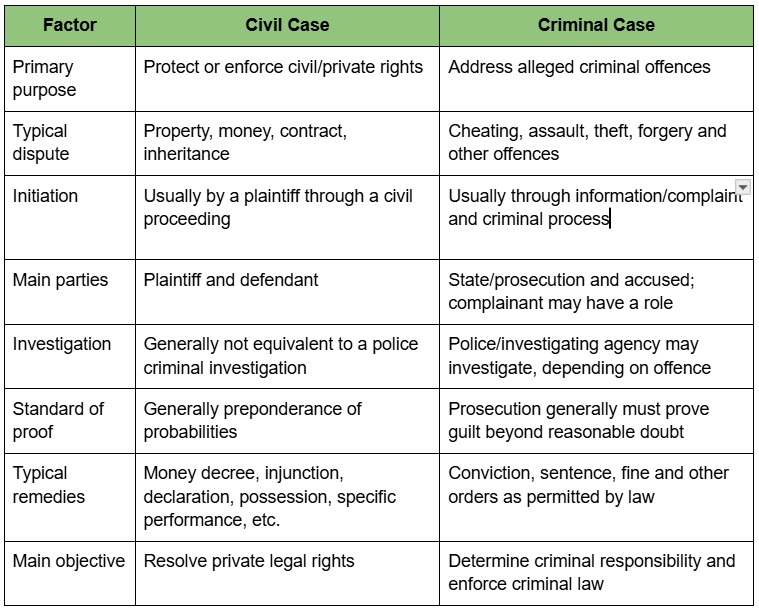
This table provides only a broad overview. The exact procedure depends on the type of case and the applicable statute.
What Happens in a Civil Case?
People searching for what happens in a civil case often imagine that filing a plaint immediately leads to a trial. In reality, civil litigation generally involves several stages.
A typical civil proceeding may involve:
- Identifying the legal cause of action.
- Determining the appropriate court and jurisdiction.
- Preparing pleadings and supporting documents.
- Filing the suit.
- Service of summons on the defendant.
- Filing of the defendant’s written statement, where applicable.
- Framing of issues.
- Production and examination of evidence.
- Cross-examination, where applicable.
- Final arguments.
- Judgment and decree.
- Execution of the decree, if necessary.
Some matters may be resolved through settlement, mediation, arbitration, or other alternative dispute-resolution mechanisms rather than proceeding through a full trial.
For example, if a business has supplied goods under a written agreement and the buyer fails to make payment, the appropriate remedy may involve a money recovery proceeding, depending on the contractual terms, evidence, limitation, and other facts.
Similarly, in a property dispute, the appropriate remedy could involve declaration, injunction, possession, partition, specific performance, or another civil remedy.
What Happens in a Criminal Case?
If you are trying to understand what happens in a criminal case, the process is different.
Depending on the nature of the alleged offence, the matter may begin through information to the police, registration of an FIR where applicable, a complaint before a competent court, or another legally recognised mechanism.
A criminal matter may involve:
- Complaint or information regarding an alleged offence.
- Registration of an FIR where legally applicable.
- Investigation by the competent investigating agency.
- Collection of documents and other evidence.
- Examination of witnesses.
- Arrest or notice in accordance with applicable law, where relevant.
- Filing of the appropriate police report/charge-sheet or complaint proceeding.
- Cognizance by the court.
- Framing of charge where applicable.
- Trial and examination of witnesses.
- Defence evidence where applicable.
- Final arguments.
- Judgment.
- Appeal or other legal remedies, where available.
The exact procedure depends on the alleged offence and applicable provisions of the BNSS and other relevant laws.
A person facing criminal proceedings should not assume that a police complaint automatically proves guilt. Criminal responsibility must be determined through the legally prescribed process.
When to File a Civil Suit or Criminal Case?
The question of when to file a civil suit or criminal case should never be answered merely by looking at the emotional nature of a dispute.
The better approach is to identify:
- What legal right has been affected?
- What exactly did the other party do?
- Is there a contractual or property dispute?
- Is there an allegation of conduct constituting a criminal offence?
- What evidence is available?
- What remedy is actually required?
- Is there a limitation period?
- Which court or authority has jurisdiction?
- Is an alternative remedy available?
For instance, a straightforward failure to repay a genuine loan may primarily raise a civil recovery issue. But if the facts also disclose an independently actionable criminal offence, criminal remedies may potentially arise.
The reverse is also important: not every disagreement should be converted into a criminal complaint simply because the parties are in conflict.
A Civil dispute lawyer Hyderabad clients can consult should first examine the underlying transaction, documents, correspondence, and legal rights before recommending litigation.
Can a Civil Dispute Become a Criminal Case?
A frequently asked question is: Can a civil dispute become a criminal case?
The accurate answer is that a purely civil disagreement does not become criminal merely because someone labels it a criminal matter. However, the same set of facts may contain elements of both a civil wrong and an alleged criminal offence.
For example, consider a property transaction involving allegations of forged documents. The ownership or contractual consequences may involve civil remedies, while alleged forgery or other criminal conduct may raise separate criminal-law issues.
Similarly, a commercial transaction may create contractual obligations while certain additional conduct, if supported by evidence and satisfying the ingredients of an offence, may raise criminal questions.
Therefore, the critical issue is not simply whether the dispute is “civil” or “criminal.” The critical question is what legal ingredients are actually present in the facts.
Can a Criminal Case and Civil Suit Be Filed Together?
Another common question is can a criminal case and civil suit be filed together?
In appropriate circumstances, yes. A civil suit and criminal case for the same dispute can potentially proceed where the same underlying facts give rise to separate civil rights and alleged criminal offences.
However, the existence of one proceeding does not automatically establish the other.
For example:
- A civil proceeding may seek recovery of money or enforcement of contractual rights.
- A criminal proceeding may concern alleged cheating, forgery, criminal breach of trust, or another offence, if the required legal ingredients are established.
The two proceedings can have different objectives, standards of proof, procedures, and outcomes.
This is why a legal professional should examine the complete factual background before advising whether one or both remedies are appropriate.
Civil Remedies vs Criminal Remedies
Understanding Civil remedies vs criminal remedies is essential before approaching a court or authority.
Civil remedies may include:
- Recovery of money
- Compensation or damages where legally available
- Injunction
- Declaration of rights
- Possession
- Partition
- Specific performance
- Enforcement of contractual rights
Criminal proceedings may ultimately result in:
- Conviction
- Imposition of sentence
- Fine
- Other orders permitted by criminal law
The purpose is fundamentally different. A civil court is generally concerned with determining and enforcing civil rights, while a criminal court determines criminal responsibility in accordance with criminal law.
This distinction matters because choosing a remedy based solely on the desire to “punish” someone may not solve the actual legal problem.
If your primary objective is to recover money, obtain possession, protect property, or enforce a contract, a civil remedy may need to be examined. If the facts disclose an offence, criminal remedies may also need consideration.
Civil Litigation and Criminal Litigation: Why Legal Strategy Matters
Both civil litigation and criminal litigation require careful preparation, but the strategy is different.
In civil litigation, documents often play a significant role. Agreements, sale deeds, title documents, invoices, bank records, correspondence, notices, photographs, and other records may become important depending on the dispute.
In criminal litigation, the investigation, admissibility and appreciation of evidence, witness testimony, procedural safeguards, and statutory ingredients of the alleged offence can become critical.
A good litigation strategy therefore begins before filing.
At Ram & Ram Associates LLP, our approach is to understand the facts first, identify the legal issue, examine available evidence, determine the appropriate remedy, and then consider the procedural route.
Difference Between Civil Suit and Criminal Case: Two Practical Examples
Example 1: Unpaid Business Dues
Suppose Company A supplies products to Company B under a written agreement. Company B receives the products but does not pay the agreed amount.
The immediate legal question is generally one of contractual and financial liability. Depending on the documents and facts, Company A may consider a civil recovery proceeding or another contractual remedy.
If there are additional facts suggesting that a criminal offence was committed, those facts must be independently examined. The mere existence of an unpaid invoice does not, by itself, establish criminal liability.
Example 2: Property Documents and Alleged Forgery
Suppose a person discovers that documents relating to their property allegedly contain forged signatures.
There may be a civil dimension involving title, declaration, cancellation, injunction, possession, or other property rights. At the same time, if the factual and legal requirements of a criminal offence are satisfied, criminal proceedings may also be relevant.
This illustrates why the Civil Suit vs Criminal Case analysis should be based on the actual facts rather than assumptions.
How Long Does a Civil Case Take in India?
People frequently ask how long does a civil case take in India. There is no single answer.
The duration can depend on:
- Nature and complexity of the dispute
- Number of parties
- Jurisdiction
- Service of summons
- Interim applications
- Number of witnesses
- Volume of documentary evidence
- Adjournments
- Court workload
- Appeals and revisions
- Execution proceedings
Some matters may settle relatively early. Others can continue for substantially longer periods, particularly where there are multiple contested issues and appellate proceedings.
Therefore, any lawyer who promises an exact completion date without examining the case should be treated cautiously.
How Long Does a Criminal Case Take in India?
Similarly, how long does a criminal case take in India cannot be predicted with a universal timeline.
Factors may include:
- Nature and seriousness of the alleged offence
- Number of accused
- Investigation requirements
- Number of witnesses
- Forensic or expert evidence
- Court workload
- Bail proceedings
- Interim applications
- Trial complexity
- Appeals
A criminal case may move through several procedural stages before final adjudication.
The appropriate approach is to assess the specific case rather than relying on generic timelines found online.
Civil Law in India and Criminal Law in India
The distinction between Civil law in India and Criminal law in India reflects two different areas of legal responsibility.
Civil law broadly deals with relationships and disputes involving private rights and obligations. It includes matters such as property, contracts, recovery, inheritance, and other civil claims.
Criminal law deals with conduct defined as offences and establishes procedures for investigation, prosecution, trial, and punishment.
Modern Indian legal practice also involves overlapping areas. A single transaction can create contractual consequences, regulatory obligations, and, depending on the conduct, potential criminal issues.
This is one reason why Civil and criminal law should not be viewed as completely isolated categories.
Civil and Criminal Lawyer Hyderabad: Why Local Legal Guidance Matters
When a dispute involves court proceedings, jurisdiction becomes an important practical issue. A Civil and criminal lawyer Hyderabad clients consult should consider where the cause of action arose, where the parties are located, where the property or transaction is situated, and which court or authority has jurisdiction.
For clients seeking a Civil lawyer in Hyderabad, the legal assessment may involve property disputes, recovery matters, contracts, injunctions, partition, declaration, or other civil claims.
For clients requiring a Criminal lawyer in Hyderabad, the assessment may involve criminal complaints, FIR-related matters, bail, investigation, trial, or other criminal proceedings.
Choosing a lawyer should not be based only on the label “civil” or “criminal.” The relevant experience, factual understanding, procedural knowledge, and ability to develop a practical legal strategy are equally important.
Civil Litigation Lawyer Hyderabad: What Should You Look For?
If you are searching for a Civil litigation lawyer Hyderabad, consider whether the legal professional can understand both the substantive dispute and the procedural requirements.
Before initiating litigation, ask:
- What is the actual legal issue?
- What remedy are we seeking?
- What evidence supports the claim?
- Is the claim within limitation?
- Which court has jurisdiction?
- Is there an arbitration clause?
- Is mediation or settlement worth considering?
- Are interim reliefs required?
- What are the likely risks?
At Ram & Ram Associates LLP, we believe litigation should be approached strategically rather than emotionally.
Criminal Lawyer in Hyderabad: When Professional Guidance Matters
If you are looking for a Criminal lawyer in Hyderabad, early legal advice can be particularly important where a police complaint, FIR, arrest risk, notice, investigation, or criminal proceeding is involved.
The appropriate legal response depends on the allegations, the statutory provisions invoked, the evidence, and the procedural stage.
Do not wait until a matter reaches an advanced stage if you reasonably believe criminal proceedings may affect you. Early assessment can help identify available legal remedies and procedural safeguards.
Criminal Lawyer in Amalapuram: Understanding Your Legal Options
For individuals searching for a Criminal lawyer in Amalapuram, the same principle applies: legal strategy should begin with understanding the facts and applicable law.
Whether the issue concerns a complaint, FIR, bail, investigation, trial, or another criminal proceeding, the correct approach depends on the specific circumstances.
A lawyer should assess the allegations, available documents, procedural status, and applicable statutory provisions before recommending the next step.
Civil Dispute Lawyer Hyderabad: Choosing the Right Remedy
A Civil dispute lawyer Hyderabad clients approach may handle matters ranging from property and inheritance disputes to recovery claims, contractual disagreements, injunctions, and specific-performance proceedings.
However, not every civil dispute needs immediate litigation.
Depending on the circumstances, an appropriate strategy may involve:
- Negotiation
- Legal notice
- Mediation
- Arbitration
- Civil suit
- Interim relief
- Appeal or execution proceedings
The correct remedy depends on the objective and facts of the dispute.
Litigation Lawyer in Hyderabad: Building a Stronger Case
A Litigation lawyer in Hyderabad should help clients understand not only the legal theory but also the practical realities of the Litigation process in India.
Strong litigation preparation usually starts with:
- Creating a clear chronology of events.
- Collecting and organising documents.
- Identifying relevant witnesses.
- Understanding the applicable legal provisions.
- Checking limitation and jurisdiction.
- Identifying strengths and weaknesses.
- Defining the desired legal remedy.
- Developing a realistic litigation strategy.
A well-prepared case is easier to understand, present, and defend.
Civil Litigation Services Hyderabad and Criminal Litigation Services Hyderabad
At Ram & Ram Associates LLP, our legal practice includes support in civil and criminal litigation matters based on the nature and requirements of each case.
Our Civil litigation services Hyderabad clients may seek assistance with property disputes, money recovery, contractual disputes, injunctions, declarations, partition, specific performance, and related civil proceedings.
Our Criminal litigation services Hyderabad may involve criminal complaints, bail-related proceedings, investigation-stage assistance, trial matters, and other criminal-law proceedings, subject to the facts and applicable law.
The firm also provides Legal consultation in Hyderabad for individuals and businesses seeking to understand their legal position before taking further action.
Civil Case vs Criminal Case: Common Mistakes to Avoid
One of the biggest mistakes people make when comparing a Civil case vs criminal case is choosing a remedy based on emotion rather than legal ingredients.
Avoid these common mistakes:
1. Filing a criminal complaint simply because money is unpaid.
A financial dispute must be examined to determine whether the facts disclose a civil claim, a criminal offence, or potentially both.
2. Ignoring limitation periods.
A valid claim can still face serious procedural problems if action is not taken within the applicable period.
3. Destroying or altering evidence.
Messages, emails, agreements, receipts, bank records, photographs, and other relevant material should be preserved.
4. Making exaggerated allegations.
Legal proceedings should be based on facts that can be supported by evidence.
5. Assuming that winning one proceeding automatically resolves everything.
Civil and criminal proceedings have different objectives and procedures.
Difference Between Civil Suit and Criminal Case: The Bottom Line
The Difference between civil suit and criminal case is ultimately about the legal nature of the dispute, the rights involved, the conduct alleged, and the remedy available.
A civil suit generally seeks to protect or enforce civil rights. A criminal case deals with alleged offences and criminal responsibility.
The Civil Suit vs Criminal Case distinction is therefore not merely a technical classification. It determines the legal route, procedural framework, evidence requirements, potential remedies, and strategic considerations involved in your matter.
If you are unsure whether your issue requires a civil proceeding, criminal complaint, both, or another legal remedy, do not rely solely on assumptions or generic online information.
>>> Also Read: How a CFO Can Help Businesses Secure Project Funding
Frequently Asked Questions About Civil Suit vs Criminal Case
1. What is the difference between civil and criminal cases?
The Difference between civil suit and criminal case primarily lies in their purpose. Civil proceedings generally address private rights and seek remedies such as recovery, injunction, declaration, possession, or specific performance. Criminal proceedings address alleged offences and determine criminal responsibility.
2. When should I file a civil suit or criminal case?
The answer to when to file a civil suit or criminal case depends on the facts. If the primary issue concerns a private legal right, such as recovery of money or property ownership, a civil remedy may be relevant. If the facts disclose an offence, criminal remedies may also need consideration.
3. Can a civil dispute become a criminal case?
Can a civil dispute become a criminal case? A purely civil dispute does not become criminal merely because it is described as such. However, the same facts may potentially involve both civil rights and conduct satisfying the ingredients of a criminal offence.
4. Can a criminal case and civil suit be filed together?
Yes, in appropriate circumstances, a civil suit and criminal case for the same dispute can proceed separately where the facts give rise to both civil and criminal legal issues. The two proceedings have different objectives and standards.
5. How long does a civil case take in India?
There is no fixed answer to how long does a civil case take in India. The duration depends on the complexity of the dispute, evidence, number of parties, court workload, interim applications, settlement possibilities, appeals, and other factors.
6. How long does a criminal case take in India?
The answer to how long does a criminal case take in India also varies. Investigation, evidence, number of accused and witnesses, procedural applications, trial complexity, court workload, and appeals can all affect the duration.
7. Can I approach a lawyer before filing a case?
Yes. In fact, obtaining Legal consultation in Hyderabad before filing can help you understand the nature of the dispute, possible remedies, limitation, jurisdiction, evidence, risks, and alternatives to litigation.
8. How do I choose between civil and criminal remedies?
Do not choose solely based on the seriousness of the dispute or the behaviour of the opposing party. A lawyer should examine the facts, documents, applicable law, available evidence, limitation, jurisdiction, and the remedy you actually need.
Conclusion: Choose the Right Legal Remedy, Not Just the Strongest-Sounding One
A legal dispute can be stressful, but reacting emotionally can make the situation harder. The right first step is to understand what legal right has been affected, what conduct has occurred, what evidence exists, and what remedy can realistically address the problem.
At Ram & Ram Associates LLP, we believe effective legal representation begins with listening carefully to the client’s circumstances and then developing a practical legal strategy. Whether you are dealing with a property dispute, money recovery matter, contractual disagreement, alleged criminal offence, or a dispute involving both civil and criminal dimensions, the correct legal route should be determined after examining the facts and applicable law.
The Civil Suit vs Criminal Case decision should never be reduced to a simple “which one is stronger?” question. The better question is: Which legal remedy actually addresses your rights and the facts of your case?
If you are looking for a Civil lawyer in Hyderabad, Criminal lawyer in Hyderabad, Civil litigation lawyer Hyderabad, Criminal lawyer in Amalapuram, or Civil dispute lawyer Hyderabad, professional legal assessment can help you understand your options before taking the next step.
Our Civil litigation services Hyderabad and Criminal litigation services Hyderabad are structured around the nature of the matter, available evidence, applicable law, and the client’s legal objectives.
Know your rights. Understand your remedies. Choose your legal path carefully.
Ram & Ram Associates LLP
Defending your rights. Protecting your future.
Legal Disclaimer: The information in this article is provided for general educational purposes only and should not be treated as legal advice for any particular person, dispute, transaction, or proceeding. Laws and procedures may change, and the outcome of any matter depends on its specific facts and applicable law. Please obtain independent legal advice before taking action. The publication of this article does not create an advocate-client relationship.
About Ram & Ram Associates LLP: The firm’s website describes its practice across Legal, CA Services, CFO/CXO, and Funding services, and states that website information is general information rather than legal advice.
Follow Us on Social Media! Stay Connected & Stay Ahead! 🤓