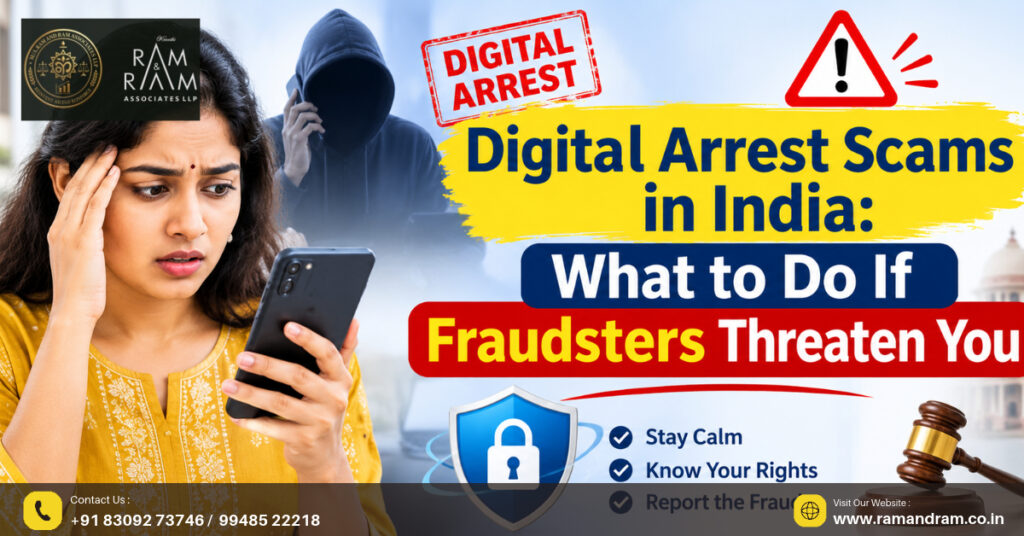
Imagine receiving a phone call from someone claiming to be a police officer, CBI official, or government authority. The caller tells you that your Aadhaar card, bank account, mobile number, or identity has been linked to a serious criminal investigation. Before you can understand what is happening, they threaten you with immediate arrest, demand confidential information, and instruct you to remain on a video call until their investigation is complete.
Sounds frightening, doesn’t it?
Unfortunately, this is how a growing number of Digital Arrest Scams in India operate. Cybercriminals are increasingly impersonating law enforcement officials and government authorities to frighten innocent individuals into transferring money or revealing sensitive financial information.
A Digital Arrest Scam in India is not an ordinary telephone fraud. It is a carefully planned form of cybercrime that uses fear, psychological pressure, fake legal documents, and impersonation to manipulate people. Through Digital Arrest Fraud, scammers make victims believe they are facing criminal charges and must cooperate immediately to avoid arrest or legal consequences.
At Ram & Ram Associates LLP, we believe that legal awareness is one of the strongest ways to protect individuals and businesses from fraud. Understanding how Digital Arrest Scams work, recognising suspicious communication, and knowing your legal rights can help prevent serious financial and personal losses.
In this article, we explain how these scams happen, the warning signs everyone should recognise, what to do if fraudsters threaten you with digital arrest, and how to report such incidents through the appropriate authorities in India.
Understanding Digital Arrest Scams in India: What Does the Term Actually Mean?
A digital arrest is a term commonly used by cybercriminals to create the impression that a person has been placed under police custody through a phone call or video conference.
However, there is no legal concept of Digital Arrest under Indian law. Government authorities cannot place someone under arrest simply by making a video call, issuing threats over WhatsApp, or demanding money through an online transaction.
An actual arrest must follow the applicable legal procedure. It cannot be replaced by an unofficial video call or an instruction from an unknown person claiming to represent a government department.
The National Cyber Crime Reporting Portal has also issued an advisory explaining how criminals impersonate police authorities, the CBI, the Narcotics Department, the RBI, the Enforcement Directorate, and other agencies to intimidate people.
The fraudsters generally attempt to convince victims that:
- A parcel registered in their name contains illegal substances, drugs, or other prohibited items.
- Their Aadhaar card or mobile number has been involved in criminal activities.
- Their bank account has received money connected to money laundering.
- They are under investigation for financial fraud or terrorist activities.
- A family member has been detained in connection with a criminal case.
- They must complete an immediate financial verification to avoid arrest.
Once the victim becomes frightened, the criminals begin demanding money under the names of verification charges, security deposits, investigation clearance, or other fabricated requirements.
The important point is that Digital Arrest Fraud is designed to make innocent people believe that they have no option except to follow the caller’s instructions. Knowing that this supposed arrest process has no legal existence is the first step towards protecting yourself.
How Do Digital Arrest Scams Work?
Most Digital Arrest Scams follow a similar pattern, although criminals frequently change their approach to make the fraud appear more convincing.
Understanding their methods can help people identify suspicious activities before suffering financial losses.
1. Receiving a Call From a Fake Government Official
The scam usually begins with an unexpected phone call.
The caller may introduce themselves as an officer from:
- Local Police Department
- Central Bureau of Investigation (CBI)
- Narcotics Control Bureau (NCB)
- Enforcement Directorate (ED)
- Telecom Department
- Customs Department
- Reserve Bank of India (RBI)
Sometimes, scammers use spoofed phone numbers, official-looking caller IDs, fake identity cards, and fabricated documents to appear genuine.
This is a common form of an Online Police Impersonation Scam, where criminals misuse the identity of government authorities to gain the victim’s trust.
2. Creating Fear Through False Criminal Allegations
After introducing themselves, scammers make serious allegations.
They may claim that your mobile number has been used for illegal activities, that your bank account is involved in money laundering, or that a parcel containing prohibited materials has been sent using your identity.
In other cases, they may claim that a close family member has been arrested or is being questioned by the police.
The intention is simple: create panic before the victim has time to verify the information.
3. Sending Fake Legal Notices and Documents
To make their claims appear genuine, fraudsters may send fabricated documents containing:
- Police department logos
- Fake arrest warrants
- Forged investigation notices
- Fake court orders
- Fabricated FIR copies
- Fake government identification cards
Some criminals also conduct video calls from rooms designed to resemble police stations or government offices.
Remember, an official-looking document or a person wearing a police uniform on a video call does not automatically establish that the communication is genuine.
4. Keeping Victims Under Continuous Video Surveillance
One of the most disturbing techniques used in Digital Arrest Scams is digital confinement.
Victims are instructed to remain connected through WhatsApp, Skype, or other video-calling applications.
They may be told not to speak to family members, visit a police station, contact a lawyer, or disconnect the call.
The criminals use continuous monitoring to prevent victims from discussing the situation with anyone who might identify the fraud.
5. Demanding Money Under the Name of Investigation or Verification
Once the victim is emotionally pressured, the scammers begin demanding money.
They may describe the payment as:
- Security verification charges
- Temporary bank account verification
- Bail or clearance payment
- Investigation deposit
- Financial compliance charges
- Refundable security amount
They may instruct victims to transfer money to specific bank accounts or UPI IDs.
In reality, these demands are part of an organised extortion attempt.
There is no legitimate requirement to transfer money to an unknown person’s account simply because someone claims to be conducting a police investigation.
Common Warning Signs of a Digital Arrest Fraud
Recognising the warning signs early can prevent serious financial damage.
If you receive a suspicious call, look out for the following indicators.
1. Threats of Immediate Arrest Over the Phone
A caller who threatens immediate arrest unless you follow instructions over a phone call should be treated with extreme caution.
2. Demands for Money to Close a Criminal Case
No genuine officer should pressure you into transferring money to a personal bank account or UPI ID to make a criminal investigation disappear.
3. Instructions Not to Contact Anyone
Scammers often tell victims not to speak with their family members, friends, advocates, or local police officers.
This is a major warning sign because isolation helps criminals maintain control.
4. Requests for OTPs and Banking Information
Never share OTPs, PINs, passwords, internet banking credentials, card details, or other confidential financial information with unknown callers.
5. Suspicious Video Calls and Fake Identity Cards
Fraudsters may use fake uniforms, government logos, forged identification cards, and fabricated office backgrounds.
Do not consider a video call sufficient proof of an officer’s identity.
6. Artificial Urgency and Psychological Pressure
Statements such as “You have only ten minutes,” “Your bank account will be frozen immediately,” or “You will be arrested if you disconnect” are commonly used to create panic.
A genuine legal matter should not require you to make an immediate payment under threats from an unidentified caller.
Why Are Digital Arrest Scams Increasing in India?
The growth of digital communication, online banking, UPI payments, and social media has created new opportunities for cybercriminals.
Although technology has made financial transactions easier, it has also enabled fraudsters to target individuals across different locations without meeting them physically.
Several factors contribute to the spread of these scams:
1. Misuse of Government and Police Identities: Criminals use the names of recognised authorities to make false allegations appear believable.
2. Lack of Cyber Fraud Awareness: Many individuals are unfamiliar with the legal procedures involved in arrest, investigation, and police verification.
3. Psychological Manipulation: Fraudsters deliberately target people’s fear of criminal allegations, social embarrassment, and legal consequences.
4. Availability of Personal Information: Information obtained through data leaks, social media, or other sources may be used to make scam calls more convincing.
5. Sophisticated Digital Tools: Fake documents, manipulated images, spoofed numbers, and AI-generated content can make impersonation attempts harder to recognise.
The increasing sophistication of these crimes makes Cyber Fraud Awareness essential for individuals, families, senior citizens, and business owners.
What to Do If Fraudsters Threaten You With Digital Arrest?
If someone calls you claiming to be a police officer and threatens you with arrest through a video call, do not panic.
Your immediate priority should be to protect yourself, prevent financial loss, and report the incident through the appropriate authorities.
Here are the important steps to follow.
1. Stay Calm and Do Not Follow Their Instructions Blindly
The first thing to remember is that scammers depend on fear.
They want you to panic so that you cannot think clearly or verify their claims.
Do not agree to any payment, investigation process, or verification procedure simply because someone threatens you.
Take a moment to understand the situation before responding.
2. Disconnect the Suspicious Call
If the caller threatens you, demands money, or instructs you to remain on a video call, disconnect immediately.
You are not legally required to remain connected to an unknown caller who claims to have placed you under digital arrest.
Do not allow the caller to control your communication or prevent you from contacting others.
3. Never Transfer Money
Do not transfer money to any bank account, UPI ID, or wallet provided by the caller.
Never agree to所谓 temporary account verification, security deposits, or refundable investigation payments.
Once money is transferred, recovering it may become difficult. Immediate reporting can improve the chances of tracing and potentially freezing the funds.
4. Preserve All Available Evidence
Do not immediately delete messages, call records, or documents received from the suspected fraudsters.
Preserve relevant information, including:
- Phone numbers used by the scammers
- WhatsApp messages and chat history
- Screenshots of video calls, if available
- Fake identity cards and legal notices
- Bank account details and UPI IDs
- Transaction reference numbers
- Payment receipts
- Dates and approximate times of communication
These details may help investigating authorities identify the persons involved and trace the financial transactions.
5. Contact Your Bank Immediately If Money Has Been Transferred
If you have already transferred money, contact your bank or payment service provider without delay.
Request that the transaction be reported as fraudulent and ask what immediate steps can be taken to secure your account or restrict further unauthorised transactions.
Do not wait for the fraudsters to contact you again.
6. Report the Incident to the Cyber Crime Helpline
For financial cyber fraud, immediately call 1930, the National Cyber Crime Helpline in India.
You can also register a complaint through the official National Cyber Crime Reporting Portal: https://cybercrime.gov.in
Providing accurate details and transaction information can help the authorities take appropriate action.
7. Inform Your Family and Consult a Legal Professional
Do not handle the situation in isolation.
Inform your family members or someone you trust about the incident.
If you receive an actual legal notice or have concerns about a genuine investigation, consult a qualified legal professional and independently verify the communication through the concerned authority.
At Ram & Ram Associates LLP, we encourage individuals to understand their legal rights before responding to suspicious legal threats.
How to Report Digital Arrest Scams in India
Many victims are unsure about where to file a complaint against digital arrest fraud.
India has established reporting mechanisms to help citizens report cybercrime incidents and financial fraud.
The following are the important reporting channels.
1. National Cyber Crime Helpline – 1930
The number 1930 is the national helpline for reporting financial cyber fraud.
If you have transferred money to scammers, contact this helpline immediately.
Be prepared to provide information such as:
- Your registered mobile number
- Name of the bank or payment service provider
- Transaction reference number
- Amount transferred
- Date and time of the transaction
- Beneficiary bank account or UPI details, if available
Prompt reporting is important because the authorities may be able to coordinate with banks and financial intermediaries to prevent further movement of the money.
2. National Cyber Crime Reporting Portal
Visit the official website: https://cybercrime.gov.in
Select the appropriate option for reporting cybercrime and provide the required information.
You may need to register using your mobile number and complete the verification process.
Explain the incident clearly and upload supporting evidence wherever requested.
After submission, retain the acknowledgement or complaint reference number for future follow-up.
3. Visit the Nearest Police Station or Cyber Crime Police Station
You can also approach the nearest police station or the designated Cyber Crime Police Station.
Provide a written complaint explaining how the fraudsters contacted you, what threats they made, whether any money was transferred, and what evidence is available.
Request an acknowledgement of your complaint.
If the matter involves financial loss or threats, provide all relevant transaction details and supporting documents.
4. Contact Your Bank and Payment Service Provider
If the fraud involves UPI, internet banking, debit cards, or other digital payment methods, immediately inform your bank or payment service provider.
Ask them to register a fraud complaint and take appropriate steps to secure your account.
Remember that reporting to your bank does not replace filing a cybercrime complaint.
Digital Arrest Fraud Prevention: How to Protect Yourself
Prevention is always better than dealing with the financial and emotional consequences of cybercrime.
Following basic digital safety practices can significantly reduce the risk of becoming a victim.
1. Verify the Identity of Anyone Claiming to Be a Police Officer
If someone introduces themselves as a police officer or government official, do not rely only on their phone number, uniform, or identification card.
Disconnect the call and independently contact the concerned department through its officially published contact details.
2. Never Share Confidential Financial Information
Never disclose:
- OTPs
- ATM PINs
- UPI PINs
- Banking passwords
- Credit or debit card details
- Internet banking credentials
No unknown caller should be given access to your financial accounts.
3. Avoid Installing Unknown Applications
Some fraudsters instruct victims to download applications or click links for supposed verification.
These applications may be designed to obtain sensitive information or gain unauthorised access to devices.
Install applications only through trusted sources and avoid suspicious links.
4. Educate Senior Citizens and Family Members
Senior citizens may be particularly vulnerable to fear-based impersonation tactics.
Explain how these scams operate and encourage family members to discuss suspicious calls before taking any action.
5. Do Not Trust Unverified Legal Documents
A document containing a police logo, official seal, or government department name is not automatically genuine.
Verify notices independently through the concerned department and seek legal assistance where necessary.
6. Strengthen Your Online Security
Use strong passwords, enable two-factor authentication, update your devices regularly, and avoid sharing personal information publicly.
These measures are important elements of Digital Arrest Fraud Prevention.
What Are the Legal Consequences of Digital Arrest Fraud in India?
Digital Arrest Fraud is not merely a misleading telephone call. Depending on the facts, it may involve several criminal offences.
The applicable legal provisions depend on the nature of the conduct, evidence, intention, and role of each person involved.
Some of the relevant legal provisions may include:
1. Bharatiya Nyaya Sanhita, 2023 (BNS)
Depending on the circumstances, provisions relating to cheating, cheating by personation, criminal intimidation, extortion, and forgery may become relevant.
For example:
- Section 318 deals with cheating.
- Section 319 deals with cheating by personation.
- Section 308 deals with extortion.
- Section 351 deals with criminal intimidation.
- Section 336 deals with forgery.
The applicability of these provisions must be examined based on the specific facts of the incident.
2. Information Technology Act, 2000
The Information Technology Act may also apply to certain cyber-enabled offences.
Relevant provisions can include:
- Section 66C – Identity theft.
- Section 66D – Cheating by personation using computer resources.
These provisions may be relevant where criminals misuse another person’s electronic identity or use computer resources to commit impersonation-based fraud.
3. Bharatiya Nagarik Suraksha Sanhita, 2023 (BNSS)
The BNSS provides the procedural framework for criminal investigations, arrests, and related legal processes.
An actual arrest or investigation must follow the applicable legal procedure.
A private individual cannot create an arrest process by threatening someone through a video call.
Important: The above provisions are indicative, not an exhaustive list. The exact offences and applicable sections depend on the facts, evidence, and investigation. Legal advice should be obtained before drawing conclusions about a particular case.
What Legal Remedies Are Available to Digital Arrest Victims?
People who have suffered losses due to digital arrest scams should not assume that nothing can be done.
Depending on the circumstances, victims may explore several legal and procedural remedies.
1. Filing a Criminal Complaint
Victims can report the incident through the National Cyber Crime Reporting Portal, the 1930 helpline, or the appropriate police authorities.
A detailed complaint supported by evidence can help initiate the investigation.
2. Requesting Immediate Financial Action
If money has been transferred, victims should immediately approach their bank and report the transaction to the cybercrime authorities.
Depending on the circumstances, authorities may coordinate with financial institutions to trace or restrict the movement of suspected fraudulent funds.
3. Preserving Electronic Evidence
Digital evidence is extremely important in cybercrime investigations.
Call records, messages, screenshots, transaction details, email communications, and other electronic records may help establish how the fraud occurred.
Preserve the original material wherever possible and avoid altering or deleting relevant evidence.
4. Seeking Appropriate Legal Assistance
A legal professional can help victims understand the applicable legal provisions, prepare complaints, organise evidence, and understand the available remedies.
If the matter involves substantial financial loss, complicated transactions, or threats of legal action, obtaining timely legal advice can be particularly important.
5. Following Up on the Complaint
After filing a Cyber Crime Complaint, retain the acknowledgement number and follow up with the concerned authorities.
If the response is not appropriate, the complainant may use the grievance mechanisms available through the National Cyber Crime Reporting Portal and the concerned police authorities.
Recovery of money is not guaranteed, but prompt reporting and proper documentation can be important steps towards pursuing the available remedies.
What to Do If Someone Impersonates a Police Officer Online?
An Online Police Impersonation Scam can be particularly convincing because criminals deliberately use the authority and reputation of law enforcement agencies.
If someone claims to be a police officer through WhatsApp, Skype, a telephone call, or another online platform, follow these precautions:
- Do not panic or accept criminal allegations without verification.
- Ask for the caller’s name, designation, department, and official contact details without sharing your confidential information.
- Do not share OTPs, banking details, passwords, or identity documents.
- Do not transfer money to settle the alleged investigation.
- Independently contact the concerned police department through its official communication channels.
- Preserve the communication and report suspicious activity to the cybercrime authorities.
- Seek legal advice if you receive a genuine notice or are unsure about your legal position.
Remember that criminals can imitate the appearance and language of government officials. Verification through independent and official channels is always safer than trusting an unexpected call.
How Ram & Ram Associates LLP Encourages Cyber Fraud Awareness and Legal Protection
At Ram & Ram Associates LLP, we believe that people should not have to face legal uncertainty because of a lack of awareness.
Digital Arrest Scams exploit people’s fear of police action, criminal allegations, and financial consequences. Many victims lose their savings simply because they do not know how to verify a suspicious call or where to report the incident.
Our approach to legal awareness focuses on helping individuals understand their rights, recognise potential legal risks, and make informed decisions.
We encourage individuals and businesses to:
- Understand the legal procedures relating to criminal investigations and arrests.
- Verify suspicious notices and communications before responding.
- Report cybercrime incidents through appropriate government channels.
- Maintain proper documentation and electronic evidence.
- Avoid making financial decisions under pressure.
- Seek appropriate legal guidance when faced with complicated legal situations.
We also believe that spreading Cyber Fraud Awareness among families, employees, senior citizens, and business communities can help prevent future incidents.
Cybercrime is constantly evolving, but awareness, timely reporting, and informed legal action can make a meaningful difference.
Conclusion: Don’t Let Fear Become a Tool for Financial Fraud – Know Your Rights and Take Action
A phone call, a fake police identity card, or a threatening video conference cannot automatically turn an innocent person into an accused individual. Yet, thousands of people face fear and financial uncertainty because cybercriminals know how to misuse the authority of law enforcement agencies.
Digital Arrest Scams in India are a serious reminder that awareness of our legal rights is just as important as protecting our digital information.
If someone threatens you with arrest over a video call, demands money for investigation clearance, or instructs you to remain under continuous digital surveillance, remember one thing: do not panic, do not pay, and do not surrender your personal or financial information.
Instead, disconnect the suspicious call, preserve the evidence, report the incident immediately through 1930 or the official cybercrime portal, and seek appropriate legal guidance.
At Ram & Ram Associates LLP, we strongly believe that legal awareness empowers people to make the right decisions during difficult situations. No individual should lose their hard-earned money because of fear created by someone falsely claiming to represent the law.
Our message to every individual is simple: Know the law. Verify before you trust. Report before it is too late.
Stay alert, protect your identity, and never allow cybercriminals to use fear as a weapon against you.
Ram & Ram Associates LLP – Legal | CA | Finance | CFO/CXO | Project Funding | Business Advisory.
Disclaimer: This article is intended for general legal awareness and informational purposes only. It should not be treated as specific legal advice. The applicability of legal provisions and available remedies depends on the facts and circumstances of each case.
>>Also Read: Legal Retainer Services: A Smarter Way for Businesses to Manage Legal Risks and Stay Compliant
Frequently Asked Questions (FAQs)
1. What is a Digital Arrest Scam in India?
A Digital Arrest Scam in India is a type of cyber fraud in which criminals impersonate police officers or government officials and threaten people with arrest through phone calls or video conferences. They use false criminal allegations and psychological pressure to demand money or confidential information. There is no legal concept of digital arrest under Indian law.
2. Can police arrest someone through a WhatsApp or video call?
No. An individual cannot be placed under arrest simply through a WhatsApp call, Skype meeting, or video conference. An actual arrest must follow the applicable legal procedure. Threats of digital arrest are a major warning sign of possible impersonation or cyber fraud.
3. What should I do if fraudsters threaten me with digital arrest?
Stay calm and disconnect the suspicious call. Do not transfer money or share OTPs, banking passwords, or personal information. Preserve call records, messages, and other evidence. Report the incident by calling 1930 or visiting the official National Cyber Crime Reporting Portal at https://cybercrime.gov.in/.
4. How to report digital arrest scams in India?
You can report digital arrest scams by calling the National Cyber Crime Helpline at 1930, registering a complaint through https://cybercrime.gov.in/, or visiting the nearest police station or Cyber Crime Police Station. If you have lost money, immediately inform your bank and provide the transaction details.
5. Can I recover money lost in a Digital Arrest Fraud?
Money recovery may be possible depending on the circumstances, the speed of reporting, the movement of funds, and the action taken by the authorities and financial institutions. Immediately contact your bank and report the financial fraud through 1930. Preserve all transaction receipts and complaint acknowledgement details. However, recovery cannot be guaranteed.
6. Where to file a complaint against digital arrest fraud?
Victims can file a complaint through the National Cyber Crime Reporting Portal (cybercrime.gov.in), call 1930 for financial cyber fraud, or approach their nearest police station or designated Cyber Crime Police Station. Keep all supporting evidence and transaction details ready.
7. Can a genuine police officer ask me to transfer money for investigation or verification?
You should never transfer money to an unknown personal bank account or UPI ID merely because someone claims to be a police officer. Demands for money under the name of digital arrest, account verification, or investigation clearance are serious warning signs of fraud. Independently verify the communication through official channels.
8. Which legal provisions apply to Digital Arrest Fraud in India?
Depending on the circumstances, provisions of the Bharatiya Nyaya Sanhita, 2023, including Sections 318, 319, 308, 351, and 336, may be relevant. Sections 66C and 66D of the Information Technology Act, 2000, may also apply to identity theft and cheating by personation using computer resources. The exact provisions depend on the evidence and nature of the offence.
9. Can senior citizens become victims of Digital Arrest Scams?
Yes. Anyone can become a victim, including senior citizens, working professionals, business owners, and students. Fraudsters often exploit fear, trust, and unfamiliarity with digital technology. Families should educate senior citizens about suspicious calls and encourage them to verify unexpected legal threats before taking any action.
10. How can I protect myself from Digital Arrest Fraud?
Never share OTPs, passwords, or banking information with unknown callers. Do not transfer money under pressure, avoid suspicious links and applications, independently verify government communications, and report suspicious activity immediately. Regular cyber fraud awareness is one of the best ways to reduce the risk of becoming a victim
Follow Us on Social Media! Stay Connected & Stay Ahead! 🤓