
Tax compliance is one of the most critical responsibilities for every business. Whether you operate a startup, an LLP, a private limited company, or a large corporation, managing taxes effectively is essential for financial stability, regulatory compliance, and long-term growth. Yet, many businesses treat taxation as a year-end activity, waiting until the filing deadline approaches before reviewing their financial records. This last-minute approach often leads to errors, missed tax-saving opportunities, compliance risks, and unnecessary stress.
On the other hand, Year-Round Tax Planning is a proactive approach that integrates tax management into everyday business operations. Instead of rushing during the filing season, businesses continuously monitor their finances, organize documentation, review tax liabilities, and implement tax-saving strategies throughout the financial year.
The debate between Tax Planning vs Tax Filing is not about choosing one over the other. Tax filing is a legal requirement, while tax planning is a strategic process that makes filing easier, more accurate, and more beneficial. Businesses that prioritize continuous tax planning are better positioned to optimize cash flow, reduce tax liability legally, and make informed financial decisions.
At Ram and Ram Associates LLP, we help businesses develop effective Tax Planning for Businesses through professional advisory, compliance support, and financial planning. In this guide, we’ll compare year-round tax planning with last-minute tax filing, highlight the benefits of proactive tax management, and explain why every business should adopt a structured tax strategy.
Year-Round Tax Planning: Why Proactive Tax Management Gives Businesses a Competitive Advantage
Many business owners believe tax planning begins a few weeks before the filing deadline. In reality, successful organizations treat tax planning as a continuous financial discipline rather than an annual obligation.
What Is Year-Round Tax Planning?
Year-Round Tax Planning is the ongoing process of monitoring income, expenses, investments, deductions, and statutory obligations throughout the financial year.
Instead of reacting to tax liabilities at the end of the year, businesses regularly evaluate their financial position and make informed decisions that improve compliance and financial performance.
A structured tax planning process typically includes:
- Regular bookkeeping
- Monthly financial reviews
- Advance tax planning
- Cash flow monitoring
- Expense tracking
- Investment planning
- Tax-saving strategy implementation
- Compliance monitoring
- Financial forecasting
This proactive approach reduces year-end pressure and supports better business planning.
What Is Last-Minute Tax Filing?
Last-minute tax filing occurs when businesses begin preparing financial records only as the filing deadline approaches.
Common activities include:
- Collecting invoices
- Reconciling accounts
- Calculating taxes
- Identifying deductions
- Preparing financial statements
- Filing Income Tax Returns
While filing the return is mandatory, postponing preparation until the final weeks often increases the likelihood of mistakes.
Why Businesses Choose Last-Minute Tax Filing
Many organizations delay tax preparation due to:
- Busy operational schedules
- Incomplete bookkeeping
- Lack of financial planning
- Limited awareness of tax regulations
- Waiting for financial statements
- Assuming tax filing is a once-a-year activity
Although these reasons are common, they often create unnecessary financial and compliance challenges.
Benefits of Year-Round Tax Planning for Businesses
Businesses that adopt proactive tax planning gain significant long-term advantages.
Better Cash Flow Management
Tax liabilities become more predictable when businesses review financial performance regularly.
Instead of making large tax payments unexpectedly, organizations can allocate funds throughout the year.
This improves working capital and reduces financial stress.
Improved Tax Savings
Continuous tax planning allows businesses to identify legitimate deductions, incentives, depreciation benefits, and investment opportunities before the financial year ends.
Waiting until the filing deadline often means missed opportunities.
Example:
A manufacturing company reviewed its capital expenditure every quarter. This allowed it to plan depreciation claims efficiently and optimize taxable income.
Stronger Business Financial Planning
Tax planning directly supports overall financial management.
Business owners can align tax strategies with:
- Expansion plans
- Hiring decisions
- Equipment purchases
- Investment planning
- Business restructuring
This creates a more integrated financial strategy.
Better Compliance
Regular monitoring helps businesses comply with:
- Income Tax regulations
- GST requirements
- TDS obligations
- Advance Tax payments
- Corporate compliance requirements
Improved Business Tax Compliance reduces the likelihood of penalties and notices.
Common Problems with Last-Minute Tax Filing
Although many businesses continue to rely on year-end tax preparation, this approach carries several risks.
Incomplete Documentation
Businesses often struggle to locate:
- Purchase invoices
- Expense bills
- Bank statements
- TDS certificates
- Investment records
- Loan documents
Missing records can delay filing and increase the risk of incorrect reporting.
Higher Risk of Errors
Preparing an entire year’s financial information within a short period increases the possibility of:
- Data entry mistakes
- Incorrect calculations
- Missing deductions
- Reconciliation errors
- Incorrect tax liability
These mistakes may result in notices, revised returns, or additional tax payments.
Missed Tax-Saving Opportunities
One of the biggest disadvantages of last-minute filing is the inability to implement proactive tax-saving strategies.
Businesses may miss opportunities related to:
- Investment planning
- Capital expenditure
- Depreciation
- Expense timing
- Tax-efficient restructuring
Proper planning allows these decisions to be made before the financial year closes.
Practical Example
Consider two businesses with similar annual revenues.
Business A follows Year-Round Tax Planning by reviewing financial performance monthly, reconciling accounts regularly, and consulting a tax advisor throughout the year.
Business B waits until the final month before the filing deadline to organize records and prepare its return.
Business A completes filing efficiently, claims eligible deductions, maintains healthy cash flow, and avoids compliance issues.
Business B experiences delayed reconciliations, missing invoices, higher professional costs due to urgent work, and increased stress while preparing returns.
This example demonstrates that proactive planning delivers measurable financial and operational advantages.
Expert Tips
To build an effective tax planning strategy:
- Update accounting records every month.
- Reconcile bank accounts regularly.
- Monitor Advance Tax obligations.
- Preserve supporting documents digitally.
- Review financial performance quarterly.
- Consult tax professionals before major investments.
- Develop a compliance calendar for all statutory filings.
These practices help businesses stay organized throughout the year.
Key Takeaways So Far
Businesses that adopt Year-Round Tax Planning benefit from:
- Better financial planning
- Improved cash flow
- Stronger compliance
- Increased tax savings
- Reduced filing stress
- Lower risk of errors
- Better business decision-making
Tax Planning vs Tax Filing: Understanding the Key Differences
Many business owners mistakenly believe that tax planning and tax filing are the same. In reality, they serve different purposes and complement each other.
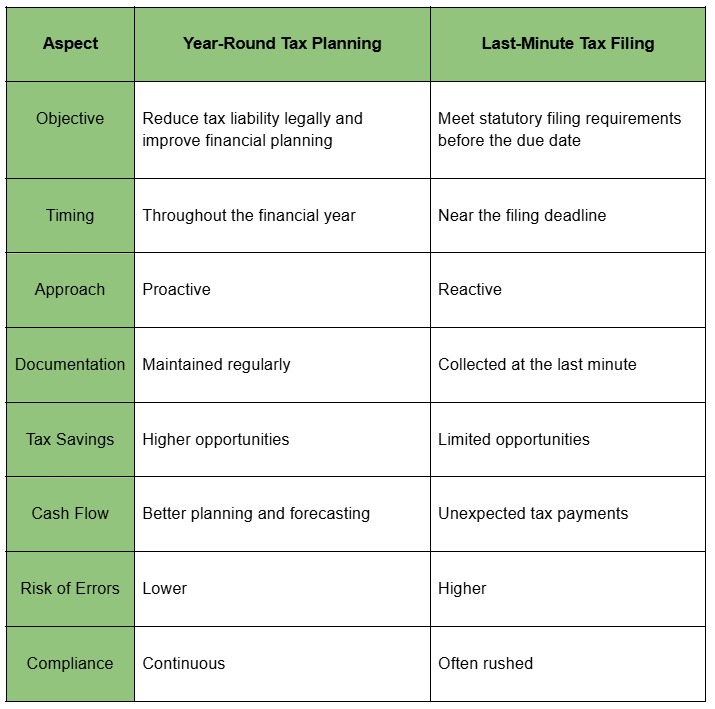
Businesses that combine effective planning with timely filing are better equipped to manage their finances and remain compliant.
How to Plan Business Taxes Throughout the Year
A proactive tax strategy helps businesses avoid year-end pressure while improving overall financial management.
Review Financial Statements Monthly
Regular review of the Profit and Loss Account, Balance Sheet, and Cash Flow Statement provides visibility into tax liabilities and financial performance.
Track Business Expenses
Maintain proper records of:
- Employee salaries
- Office expenses
- Travel costs
- Marketing expenses
- Software subscriptions
- Professional fees
- Asset purchases
Accurate expense tracking supports both tax deductions and financial reporting.
Monitor Advance Tax
Estimate taxable income periodically and ensure advance tax payments are made within the prescribed timelines to avoid interest and penalties.
Reconcile GST and Accounting Records
Regular reconciliation minimizes discrepancies between GST returns and financial statements.
Review Investments
Evaluate business investments throughout the year to maximize eligible tax benefits and support long-term growth.
Business Tax Planning Checklist
A structured checklist simplifies tax planning and strengthens compliance.
Ensure your business has:
- Updated books of accounts.
- Monthly bank reconciliations.
- Accurate sales and purchase records.
- GST reconciliations.
- TDS verification.
- Advance Tax payment records.
- Fixed asset register.
- Depreciation calculations.
- Supporting invoices and bills.
- Payroll records.
- Investment documentation.
- Loan statements.
- Statutory compliance calendar.
- Previous Income Tax Returns.
- Financial forecasts for the upcoming year.
Following this checklist reduces last-minute pressure and supports accurate Income Tax Return Filing.
How to Avoid Last-Minute Tax Filing Mistakes
Many businesses encounter avoidable problems because tax preparation begins too late.
Keep Books Updated
Avoid waiting until year-end to record transactions.
Preserve Supporting Documents
Maintain digital and physical copies of invoices, challans, contracts, and financial records.
Conduct Quarterly Tax Reviews
Periodic reviews help identify discrepancies before they become major compliance issues.
Review Tax Deductions Early
Identify eligible deductions throughout the financial year rather than searching for them at the last moment.
Work with Experienced Tax Professionals
Professional guidance helps businesses remain compliant while identifying legitimate tax-saving opportunities.
Why Professional Tax Planning Matters
Tax regulations continue to evolve, making compliance increasingly complex.
Professional Tax Advisory Services provide businesses with strategic guidance beyond simple return filing.
Benefits include:
- Better tax planning.
- Accurate return preparation.
- Regulatory compliance.
- Tax optimization strategies.
- Financial forecasting.
- Audit preparedness.
- Business restructuring advice.
- Risk management.
Businesses seeking Tax Planning Services Hyderabad, Income Tax Consultant Hyderabad, Business Tax Consultant Hyderabad, or Corporate Tax Consultant Hyderabad benefit from expert advice tailored to their industry and business model.
Best Practices for Corporate Tax Planning
Successful businesses integrate tax planning into their overall financial strategy.
Recommended practices include:
- Develop an annual tax calendar.
- Review budgets quarterly.
- Monitor taxable income regularly.
- Plan capital investments strategically.
- Maintain proper documentation.
- Evaluate tax-saving opportunities before year-end.
- Reconcile statutory records periodically.
- Conduct annual compliance reviews.
- Consult professional advisors before significant financial decisions.
These practices improve both compliance and financial efficiency.
Why Choose Ram and Ram Associates LLP?
Effective tax planning requires experience, accuracy, and a thorough understanding of evolving tax regulations.
At Ram and Ram Associates LLP, we provide comprehensive tax advisory and compliance solutions designed to help businesses remain compliant while optimizing financial performance.
Our services include:
- Income Tax Return Filing
- Business Tax Planning
- Corporate Tax Planning
- Income Tax Advisory
- Tax Compliance Services
- Corporate Tax Filing
- Business Tax Compliance
- Financial Tax Planning
- Tax Optimization Strategies
- Corporate Tax Services
- Compliance reviews
- Business financial planning
- Strategic tax advisory
Whether you are a startup, SME, LLP, or large corporate organization, our experienced professionals help simplify tax management while supporting your long-term business goals.
Businesses searching for Tax Planning Services Hyderabad, Corporate Tax Services Hyderabad, or Income Tax Consultant Hyderabad can rely on our practical, client-focused approach.
Key Takeaways
The comparison between Year-Round Tax Planning vs Last-Minute Tax Filing clearly demonstrates that proactive planning provides significant advantages.
Businesses that adopt continuous tax planning benefit from:
- Improved compliance.
- Better cash flow.
- Reduced tax liability.
- Lower filing stress.
- Stronger financial planning.
- Greater operational efficiency.
- Fewer compliance risks.
- Better business decision-making.
Tax filing is a statutory obligation, but tax planning is a strategic business advantage.
Conclusion
Managing taxes effectively is not just about meeting filing deadlines – it is about building a financially strong and compliant business. The difference between Year-Round Tax Planning and Last-Minute Tax Filing lies in preparation, strategy, and long-term financial management.
Businesses that plan throughout the year are better positioned to optimize tax liabilities, maintain accurate financial records, improve cash flow, and avoid unnecessary compliance issues. In contrast, businesses that rely solely on last-minute filing often miss valuable tax-saving opportunities and face increased risks of errors, penalties, and financial stress.
At Ram and Ram Associates LLP, we believe that proactive Tax Planning for Businesses is one of the most effective ways to strengthen financial performance and ensure statutory compliance. Our experienced professionals provide comprehensive Business Tax Planning, Corporate Tax Planning, Income Tax Advisory, and Tax Compliance Services tailored to the unique needs of businesses across industries.
Whether you’re looking for Tax Planning Services Hyderabad, Business Tax Consultant Hyderabad, Corporate Tax Consultant Hyderabad, or expert guidance to simplify your tax compliance process, our team is here to support you.
Visit https://ramandram.co.in/ to explore our tax advisory services and discover how strategic tax planning can contribute to the long-term success of your business.
Frequently Asked Questions (FAQs)
1. What is Year-Round Tax Planning?
Year-Round Tax Planning is the continuous process of managing taxes throughout the financial year by monitoring income, expenses, investments, deductions, and compliance obligations rather than waiting until the filing deadline.
2. How is Tax Planning different from Tax Filing?
Tax Planning is a proactive strategy focused on reducing tax liability legally and improving financial management, while Tax Filing is the statutory process of submitting Income Tax Returns to comply with legal requirements.
3. Why is Year-Round Tax Planning better than Last-Minute Tax Filing?
Year-round planning helps businesses improve cash flow, identify tax-saving opportunities, reduce errors, maintain compliance, and avoid the stress associated with rushed tax preparation.
4. What are the common problems with Last-Minute Tax Filing?
Common issues include incomplete documentation, calculation errors, missed deductions, delayed reconciliations, compliance risks, and increased chances of receiving tax notices.
5. How can businesses improve their tax planning?
Businesses should maintain updated books of accounts, reconcile financial records regularly, monitor advance tax, preserve documentation, review financial performance periodically, and seek professional tax advice throughout the year.
6. Why should businesses choose Ram and Ram Associates LLP for tax planning?
Ram and Ram Associates LLP offers professional tax planning, compliance management, corporate tax advisory, Income Tax Return Filing, and strategic financial guidance to help businesses remain compliant while improving financial efficiency and supporting sustainable growth.
Follow Us on Social Media! Stay Connected & Stay Ahead! 🤓